Mexico’s Cotton Comeback: Bigger Crop, But Textile Mills Still Facing Tough Road
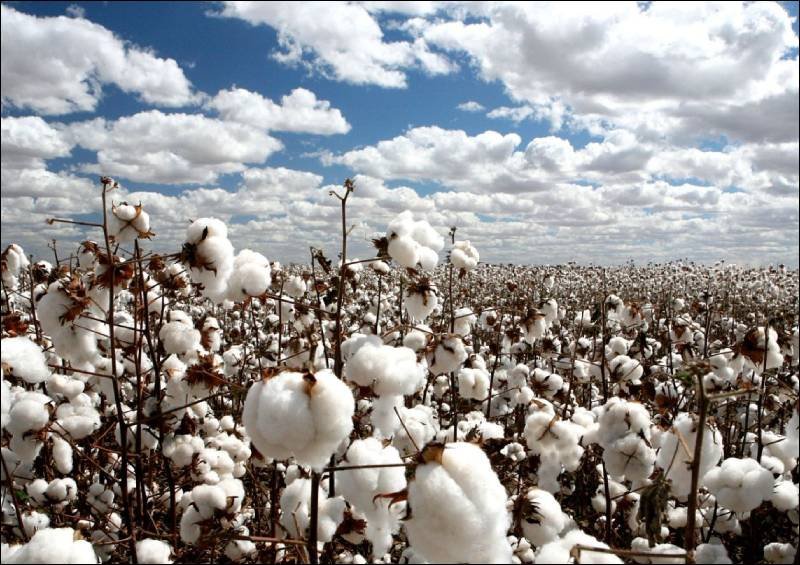
Mexico’s cotton sector is showing signs of a comeback. After hitting historic lows, cotton production is expected to jump by nearly a third in the 2026-27 marketing year, helped by better prices and farmers in Chihuahua returning to cotton.
But there is a catch.
The bigger cotton crop may not translate into stronger domestic textile demand. High input costs, water concerns, outdated seed varieties, sluggish consumer spending and a flood of low-priced Asian textile imports continue to weigh on Mexico’s spinning, weaving and apparel industries.

According to the latest USDA Foreign Agricultural Service (FAS) report, Mexico’s cotton production is forecast to rise 32 per cent to 869,000 480-lb bales in MY 2026-27, from an estimated 656,000 bales in the previous marketing year. Planted area is expected to increase by 37 per cent to 96,760 hectares.
Cotton prices bring farmers back
The biggest reason behind the turnaround is simple: cotton has become more attractive financially.
Cotton fibre prices have risen by around 40 per cent since reaching a low in February 2026, improving its competitiveness against alternative crops. Farmers in Chihuahua, Mexico’s largest cotton-producing state, are consequently shifting acreage back to cotton after moving towards grains and other crops in the previous season.
Chihuahua alone is expected to account for around 85,000 hectares of planted area and approximately 800,000 bales of production in 2026-27, making it the overwhelming contributor to Mexico’s cotton recovery.
Other regions, however, are not following the same path. Baja California is expected to see an 18 per cent decline in planted area because of weak profitability.
Water remains a worry
Better rainfall has provided some relief, but water remains one of the biggest risks facing Mexican cotton growers.
Drought conditions across major cotton-producing states eased by July, while early-season rainfall in Chihuahua, Coahuila and Tamaulipas supported crop development and reduced initial irrigation requirements.
Yet the improvement has not eliminated the underlying problem. A persistent long-term moisture deficit means growers will continue to depend heavily on irrigation and available well water.
Mexico’s new water legislation could make the situation even more complicated. Under the framework introduced in December 2025, human consumption is prioritised over agricultural use, while the National Water Commission can reduce agricultural water allocations during periods of scarcity.
For cotton, a crop that depends heavily on managed irrigation in northern Mexico, water availability could therefore become just as important as cotton prices.
Old seeds, rising costs
Farmers may be returning to cotton, but producing it is becoming more expensive. Input costs have risen by around 30 per cent, while Mexican growers continue to face limited access to newer genetically engineered cotton varieties. The government has not approved new GE cotton planting permits since 2019, leaving growers largely dependent on obsolete varieties that are increasingly difficult to source.
That could limit the benefits of the acreage recovery.
The USDA expects production to increase substantially, but the yield forecast remains constrained by input costs and the limitations of available seed technology.
Bigger crop, but where are the buyers?
This is where Mexico’s cotton story gets complicated.
Despite the production recovery, domestic cotton consumption is forecast to remain at only 1.3 million bales in 2026-27. That is still well below the pre-pandemic level of around 1.8-1.9 million bales.
The reasons are familiar: consumers are watching their spending, textile mills are operating below capacity and cheaper imported fabrics, garments and yarns—particularly from Asia—continue to compete with domestic production.
Mexico’s textile product manufacturing declined 2.5 per cent year-on-year in June 2026, while apparel manufacturing fell 1.9 per cent. Employment also declined, with textile product manufacturing jobs down 4.5 per cent and apparel employment down 2.6 per cent.
Industry data from CANAINTEX suggests factories are operating at only 60-70 per cent of installed capacity.
That means the additional cotton produced locally may not automatically create a corresponding increase in domestic fibre consumption.
Asian imports remain the big headache
Mexico’s textile industry is facing another formidable competitor: inexpensive Asian imports.
The USDA report notes that fabrics and clothing entering through both formal and informal channels are putting pressure on local manufacturers. E-commerce platforms have added another layer to the competition by making low-priced Asian products increasingly accessible to Mexican consumers.
The Mexican government has responded with a series of trade measures, including higher tariffs on textile and apparel products from countries without free-trade agreements and measures aimed at addressing undervalued imports.
One particularly significant move came in May 2026, when the government prohibited foreign textiles and apparel from entering Mexico through Strategic Bonded Warehouses after industry data indicated that sub-valued imports through these channels had increased dramatically.
Whether these measures can translate into a sustained recovery for domestic textile manufacturing remains to be seen.
A new opportunity is coming from public procurement
There is, however, a potential bright spot. From January 2027, new public procurement provisions will require bed linen and surgical apparel purchased by Mexican public institutions to contain at least 65 per cent Mexican-manufactured content.
The measure could provide a direct source of demand for domestic textile manufacturers and, in turn, support the use of locally produced cotton and yarn.
The impact is unlikely to be immediate, but if implemented effectively, the policy could provide domestic mills with an important new market.
Imports remain important despite the production recovery
Mexico will not become self-sufficient in cotton simply because production is rising.
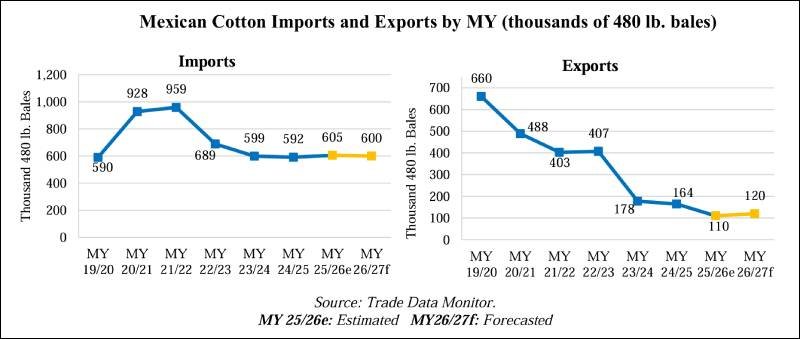
FAS forecasts cotton imports at around 600,000 bales in MY 2026-27, only slightly below the previous year’s level. The United States is expected to retain its dominant position because of quality, geographical proximity and preferential access under the US-Mexico-Canada Agreement (USMCA).
This highlights an important characteristic of Mexico’s cotton market: domestic production and imports are not necessarily substitutes.
Mexican mills continue to require imported fibre, while the US remains the industry’s most important external supplier.
Exports set to recover
Mexico’s cotton exports are expected to move higher as well, although from a relatively low base.
FAS forecasts exports of 120,000 bales in MY 2026-27, a 9 per cent increase driven by higher domestic production. Most Mexican cotton is consumed within the country’s textile and apparel industry, with smaller volumes exported to China, Pakistan and Turkey.
The increase follows a sharp decline in the previous season, when exports were estimated at 110,000 bales, 34 per cent below the preceding marketing year.
Prices are moving up
The global cotton market is also providing some support to growers. On August 20, 2026, cotton on the New York Stock Exchange was quoted at 86.96 cents per pound, 23 per cent higher than the same date a year earlier. However, prices remain below the 2022 average of 112 cents per pound.
For Mexican farmers, the price recovery has clearly been enough to bring some acreage back into cotton.
The question is whether prices can remain attractive enough to offset rising production costs, water constraints and the risks associated with older seed varieties.
Mexico’s cotton revival has a long way to go
The 2026-27 outlook represents a welcome improvement for Mexican cotton growers. Production is rising, acreage is recovering and exports are expected to improve.
But the broader textile industry is telling a different story. Domestic cotton consumption remains stuck at historically low levels. Mills are operating below capacity, employment is declining and Asian imports continue to challenge local manufacturers. At the same time, water availability, input costs and seed technology remain structural concerns for farmers.
Mexico’s cotton sector, therefore, is not yet experiencing a full-fledged revival. It is more accurately a recovery in production taking place alongside a struggling domestic textile market.
The next few seasons will determine whether higher cotton prices and government support measures can turn that production recovery into something bigger a stronger, more competitive Mexican textile value chain.