India’s US$ 96 Billion Apparel Market Set To Hit US$ 146 Billion By 2029
Rural India, casualisation, womenswear and kidswear emerge as key growth drivers as consumer preferences reshape the country’s apparel landscape
India’s apparel market is entering a new growth cycle, with the domestic market projected to expand from US$ 95.7 billion in CY2025 to US$ 146.3 billion by CY2029, registering a CAGR of around 9%, according to a new consumer research report by the Clothing Manufacturers Association of India (CMAI) in association with 1Lattice.
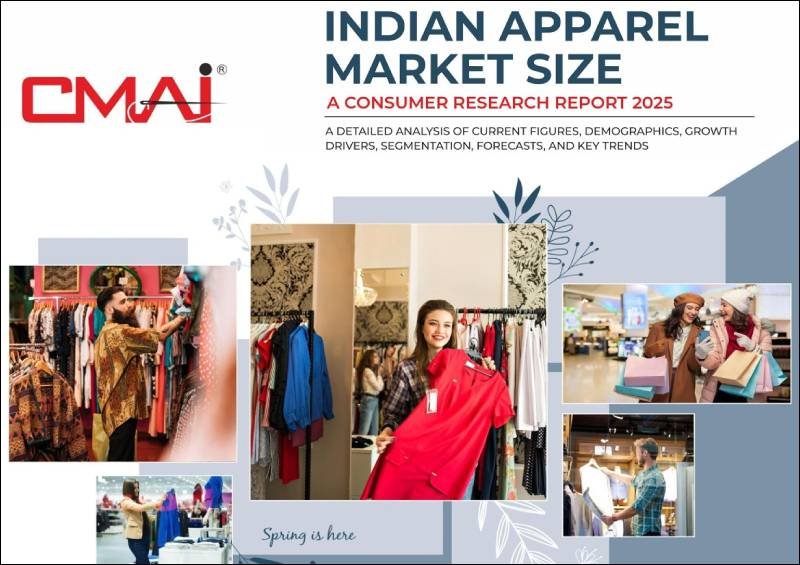
The Indian Apparel Market Size: A Consumer Research Report 2025 places India among the world’s largest apparel markets and highlights a fundamental shift in consumption, driven by rising aspirations beyond the metros, rapid casualisation, growing demand for womenswear and kidswear, changing lifestyles and the increasing importance of comfort and functionality.

India’s apparel market has already nearly doubled since the pandemic, rising from US$ 49.3 billion in CY2020 to US$ 95.7 billion in CY2025, representing an 18% CAGR during the period.
However, the next phase of growth is expected to look very different from the previous one. The report indicates that rural and smaller-town India will be at the centre of apparel consumption, while changing consumer preferences will continue to blur traditional boundaries between formalwear, casualwear, ethnicwear and athleisure.
Rural India emerges as the biggest opportunity
One of the strongest findings of the study is the sheer size of apparel consumption outside India’s major cities.
Of the US$ 95.7 billion apparel market in CY2025, rural India accounted for US$ 55.9 billion, or nearly 58% of total consumption. Metro and Tier-1 markets together contributed US$ 14.2 billion, while Tier-2 markets accounted for US$ 8.5 billion and Tier-3 and smaller markets for US$ 17.1 billion.
The numbers suggest that the next phase of apparel growth will increasingly be driven by consumers outside the traditional metropolitan markets.
For brands and manufacturers, this creates opportunities as well as challenges around distribution, pricing, product assortment, regional preferences and localised merchandising.

Santosh Katariya, President of CMAI
Santosh Katariya, President, CMAI, said the next phase of growth would increasingly come from markets beyond the metros.
“Tier-2 and Tier-3 cities are already contributing significantly to apparel consumption, while rising aspirations are creating demand for a wider choice of brands, formats and fashion,” he said.
According to Katariya, the opportunity is now to develop contemporary and accessible propositions while strengthening distribution and retail presence across emerging markets.
Casualwear takes the lead
Casualwear has emerged as India’s largest apparel occasion, accounting for 31% of the market, ahead of ethnicwear at 27% and formalwear at 26%.
The shift reflects changing lifestyles and a growing preference for clothing that offers comfort, versatility and functionality.
In menswear, the trend is particularly visible in the growing demand for T-shirts, denims and athleisure products. Quick-dry T-shirts, stretch joggers and moisture-wicking polos are increasingly becoming part of everyday wardrobes rather than being restricted to sports and fitness activities.
The same trend is visible in kidswear, where parents are showing greater interest in comfortable, breathable and activity-oriented clothing.
Rahul Mehta, Chief Mentor, CMAI, said traditional category boundaries are increasingly becoming blurred.
“One of the most significant shifts in India’s apparel consumption is the blurring of traditional category boundaries,” Mehta said, adding that menswear is becoming more casual, comfortable and versatile as consumers seek clothing that can move between work, leisure and social occasions.
At the same time, womenswear continues to retain strong ethnic roots while evolving through new silhouettes, Indo-Western styling and greater versatility.
Womenswear and kidswear gain momentum
Menswear remains India’s largest apparel segment, valued at US$ 38.5 billion in CY2025, followed by womenswear at US$ 35.6 billion and kidswear at US$ 21.6 billion.
The growth outlook, however, points towards faster expansion in womenswear and kidswear.
Between CY2025 and CY2029, kidswear is projected to grow at 9.4% CAGR, followed by womenswear at 8.9% and menswear at 8.5%.
Kidswear is expected to reach around US$ 34 billion by CY2029, while womenswear could approach US$ 55 billion.
The growth in womenswear is being supported by rising workforce participation, increasing adoption of athleisure and the growing popularity of Indo-Western styles. The report also points to increasing consumer interest in sustainable and ethical fashion.
Ethnicwear remains a powerful force
The rapid rise of casualwear does not mean traditional apparel is losing relevance.
Ethnicwear continues to account for 27% of India’s overall apparel market and around 60% of womenswear. Sarees and salwar suits remain among the largest womenswear categories, while weddings and celebrations continue to generate strong demand for men’s ethnic and occasionwear, including sherwanis, bandhgalas and Indo-Western outfits.
This creates a distinctive characteristic of the Indian market: casualisation and traditional consumption are growing side by side.
Consumers may increasingly wear casual clothing in their everyday lives, but festivals, weddings and social occasions continue to sustain demand for traditional and occasion-led apparel.
Physical stores still dominate
Despite rapid digital adoption, India’s apparel market remains overwhelmingly offline.
Offline retail accounted for 83% of apparel sales in CY2025, equivalent to approximately US$79.4 billion, while online sales stood at US$ 16.3 billion, or 17% of the market.
Exclusive Brand Outlets accounted for approximately half of offline apparel sales.
Within online apparel sales, marketplaces dominated with around 80% of sales, while D2C websites accounted for the remaining 20%.
The findings suggest that e-commerce is expanding the consumer journey rather than replacing physical stores. Consumers are increasingly discovering products digitally but continue to rely heavily on physical retail for browsing, trial and purchase.
For apparel companies, therefore, the opportunity lies increasingly in omnichannel retail rather than an online-versus-offline strategy.
A market driven by multiple growth engines
Category-level data further illustrates the diversity of India’s apparel opportunity.
In menswear, formalwear was the largest category at US$ 17.1 billion, followed by casualwear at US$ 15.5 billion. In womenswear, ethnicwear remained dominant at US$ 21.2 billion. In kidswear, casualwear accounted for US$ 9.4 billion, ahead of formalwear at US$7 billion.
The findings indicate that India’s apparel expansion is not being driven by one category or one consumer segment. Instead, rising incomes, increasing aspirations, changing lifestyles, urbanisation beyond the major cities, category innovation and wider access to brands are collectively expanding the market.
The study’s findings are also broadly reinforced by business and market trends reported by leading listed apparel companies, including Aditya Birla Fashion & Retail, Arvind Fashions, Raymond, Page Industries, Kewal Kiran Clothing, Vedant Fashions, Gokaldas Exports, Cantabil Retail and TCNS Clothing.
The next battle will be for the emerging consumer
The scale of rural and non-metro consumption also highlights the importance of India’s fragmented apparel ecosystem.
The next phase of growth is unlikely to come only from premium branded consumers. A significant opportunity lies in first-time branded consumers, consumers upgrading from unorganised to organised retail and aspirational consumers seeking better products at accessible price points.
This makes value-for-money positioning increasingly important for brands and manufacturers.
For manufacturers, the changing market will require greater flexibility, faster product development and the ability to respond to regional demand. Brands will need sharper consumer segmentation, while retailers will have to build stronger regional assortments and seamless online-offline experiences.
With the domestic apparel market projected to add nearly US$ 50 billion between CY2025 and CY2029, India’s next growth story is increasingly moving beyond the metros. The combination of rural consumption, casualisation, rising womenswear and kidswear demand, and continued strength of physical retail is creating a broader and more diverse opportunity across the entire apparel value chain.