A Short Story of Mint, Xylitol And Japanese Self-Cooling Fabric Miracle
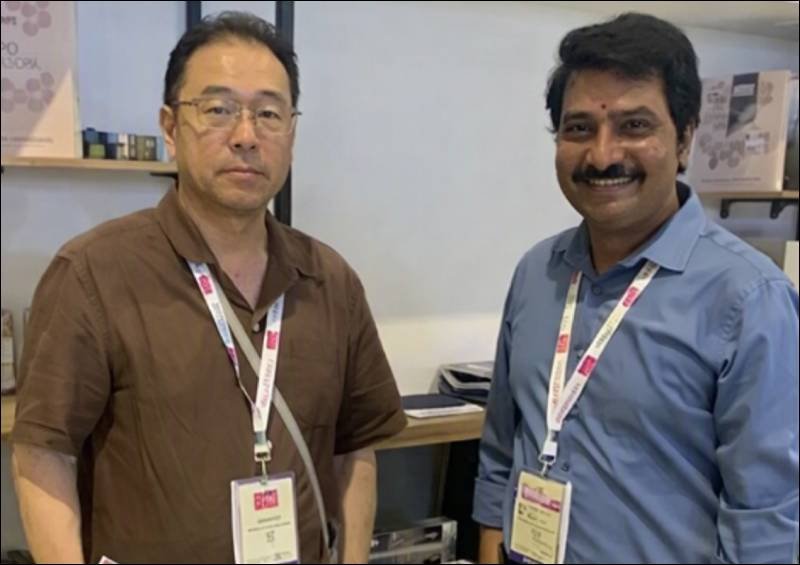
By S. Murugan
The summer had arrived early that year — not gently, not politely, but like an uninvited guest kicking down the door.
In Gujarat, the spinning mill where I visited as a ‘process co-ordinator’, workers joked that the sun had taken a personal interest in them.

But no one laughed for long. The heat was merciless.
Inside the mill, arguments about climate change floated like dust in the air.
“Climate change is real!” shouted Ravi, the young technician who read scientific journals in his lunch break.
“Nonsense! It’s all propaganda!” countered Ramesh, the senior technician who trusted only his own experience.
But whether they believed or denied, both men wiped sweat from their foreheads. The heat didn’t care about opinions.
I watched them with a quiet smile. I had heard these debates everywhere — in news channels, in WhatsApp groups, even in tea shops.
But I knew one thing for certain: Whether climate is changing or not, the heat is definitely changing us.
I remembered my childhood summers — sleeping peacefully under a fan, no AC, no fancy cooling.
Now I couldn’t sleep without the AC blasting and a blanket wrapped around me like a polar explorer.
Humans had become psychologically tuned to comfort. Even a small rise in temperature felt unbearable.
In Gujarat, by May, the spinning department would feel like a pressure cooker. The wet‑bulb temperature hovered around 30°C — the danger zone where sweat stops evaporating.
Workers would move slowly, their shirts soaked, their faces flushed. Productivity would dip. Tempers would rise.
I wished something had to change.
I had been dreaming for years of giving workers cooling garments — the kind used in sports, military and high‑heat industries.
But such garments were expensive, experimental, or impractical: PCM (Phase Changing Material) vests that absorbed heat, Evaporative cooling suits that needed water, and Liquid‑circulating vests that required pumps and tubes..Nothing seemed right for a spinning mill.
Until one phone call changed everything.
The Invitation
“Murugan sir,” said my friend Mahesh over the phone, “I’ve tied up with a Japanese company. We’re displaying self‑cooling fabrics at the Bharat Tex Exhibition in Delhi. You must come.”
I didn’t hesitate. Delhi welcomed me with a slap of heat.
Unlike South India, where nights cooled with sea breeze, Delhi stayed hot day and night, like the city had forgotten how to breathe.
Inside the exhibition halls, the AC hummed like a lullaby. Outside, the heat roared like a beast.
The Japanese Demonstration
Mahesh’s stall was buzzing with visitors.
At the centre stood a calm, polite Japanese man named Hyodo, wearing an expression of serene confidence.
“Murugan‑san,” he said, bowing slightly, “Welcome. We have something special for you.”
He showed me two cooling arm‑covers, a cooling inner‑wear T‑shirt, and a vest with fans mounted at the back and under the armpits
I slipped on the garments and stepped outside the hall.
At first, nothing. The sun still burned. The air still pressed against my skin.
Then I began to sweat. And suddenly — the fabric awakened.
A cool wave spread across my body. Not mint‑candy cool. Not prickly‑heat powder cool.
But real cooling, the kind that comes from physics, not illusion.
I gasped. Hyodo-san smiled knowingly.
The Mint Trick
“Mint,” said Hyodo san, “is clever. It does not cool your body. It only tricks your sensors.”
He tapped my arm gently. “Your skin has TRPM8 receptors. They detect cold. Menthol binds to them and makes your brain think you are cold. Though the temperature does not change much, you will feel comfortable.”
I nodded. I had felt that mint trick many times — in candies, powders, balms. But this fabric felt different.
The Xylitol Truth
“Xylitol,” Hyodo san continued, “is real cooling. When sweat touches it, xylitol dissolves. Dissolving absorbs heat. Endothermic reaction.”
He drew a small diagram on a notepad: Xylitol + Sweat → Heat Absorption → Cooling
“And our fabric,” he added proudly, “keeps this effect even after 50 washes. Patented process.”
My eyes widened. Fifty washes?
Most cooling finishes died after a few washes. This was a breakthrough.
“And UPF?” I asked. “66.7,” Hyodo san replied. “Sun cannot hurt you.”
The Drama in the Mill
When I returned, I brought some samples. I wanted to try it in a mill condition at my place.
One of my mill friends wore the cooling T‑shirt and stepped into the spinning hall and spent about half an hour briskly walking in between the ring frames.
When he returned he seemed more excited. “Anna… this feels like AC!” he shouted.
Another friend tried the fan vest. When he came back he happily shared his experience.
“Who cares about climate change?” he laughed. “This vest is changing my climate!”
For the first time in months, I felt hopeful. I knew this wouldn’t entirely replace chiller plants, which are necessary during adverse climate conditions.
But it could reduce load, improve comfort and protect workers during the brutal summer months.
It was a start. A human‑centred solution in a world arguing endlessly about climate.
The Final Realization
That night, I sat outside my home, feeling the warm breeze. I thought of mint tricking the skin and xylitol absorbing heat. And I thought of the workers — sweating, struggling, surviving.
Whether climate was changing or not, the world needed cooling. I thought it might be the answer for the mills, especially in Gujarat.
Not only for comfort, but for improving productivity.
I smiled. I had found something worth fighting for.
A fabric that didn’t just cover people…but protected them from the world’s heat.
A fabric that carried science, hope and a little Japanese magic.
And maybe — just maybe — this was how the future would be woven.