From Waste To Worth: How The UK Plans To Turn 744,000 Tonnes Of Textile Trash Into A Circular Economy

Every year, the United Kingdom discards nearly three-quarters of a million tonnes of textiles that can no longer be reworn. These clothes and fabrics, often tossed into household bins or collection banks, end up incinerated, landfilled, or shipped abroad. Less than one per cent of them ever find their way back into new fibres.
Now, a sweeping new report from the Action, Collaboration, Transformation (ACT UK) consortium argues that this waste mountain is not just an environmental scandal—it’s also an untapped economic opportunity. If Britain can build the right infrastructure, it could transform old clothes into raw materials, fuelling a domestic recycling industry that creates jobs, reduces imports, and places the country at the forefront of circular fashion.
The Scale of the Challenge
The numbers are stark. According to the report, Britain generates 744,000 tonnes of post-consumer non-rewearable textiles each year. Globally, the picture is little better: just 1% of all textiles ever produced are recycled into new fibres.
“The UK is losing billions in material value annually,” said Adam Mansell, CEO of the UK Fashion and Textile Association (UKFT), which spearheaded the ACT UK programme. “We have the ability to turn that waste into opportunity—but only if we build the systems to capture it.”
Across Europe, momentum is already gathering. McKinsey forecasts that by 2030, textile-to-textile recycling could account for up to a quarter of waste, creating 15,000 green jobs and cutting millions of tonnes of carbon. Britain, the report warns, risks being left behind unless it invests now.
The Case for Automation
At the heart of ACT’s vision is an Automated Textile Sorting and Preprocessing (ATSP) facility. The idea is simple: instead of relying on costly and inconsistent manual sorting, machines using advanced scanning and fibre identification would separate textiles at scale. The output—consistent, high-quality feedstock—would then flow into fibre-to-fibre recycling plants.
Circle-8, one of the consortium partners, has calculated that the UK has enough discarded textiles to supply 12 such facilities, each capable of processing 50,000 tonnes annually. Yet not one is currently operational.
“The technology is there,” said one industry expert involved in the project. “The barrier is not science—it’s investment and coordination. Without automated sorting, recyclers can’t scale. Without recyclers, investors won’t back sorting. We need to break this loop.”
The first ATSP is already on the drawing board, with plans to be operational by 2026. The report stresses that this pilot must be the beginning of a nationwide network, not an isolated project.
Trials in Collection and Consumer Behaviour
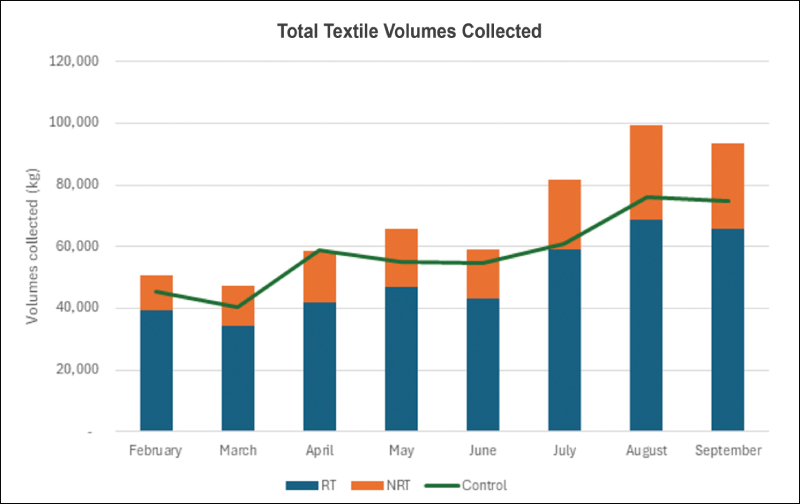
ACT didn’t stop at technology. Recognising that any recycling system is only as good as the textiles that enter it, the consortium ran a series of collection trials across the UK. These ranged from bring banks in Tesco car parks and postal return schemes with M&S and Oxfam, to in-store experiments with Crisis and Reskinned’s take-back partnerships.
The results were mixed but revealing. Citizens showed strong enthusiasm for recycling, often motivated by environmental concerns. Some schemes saw donation volumes rise by more than 25%. But when it came to correctly separating reusable from non-reusable textiles, accuracy fell short of the levels needed for automated plants.
Still, campaigners see this as progress. “People want to do the right thing,” said one participant from Salvation Army Trading Company Ltd., which operates the UK’s only automated sorting line today. “With better education, clearer instructions, and incentives, we can dramatically improve pre-sorting.”
Barriers Beyond Technology
The report is candid: building a circular textile economy will take more than enthusiasm. Key obstacles include:
- Policy gaps: Unlike in some EU countries, the UK has no mandated Extended Producer Responsibility (EPR) scheme for textiles. Without it, funding for infrastructure is limited.
- Market demand: Brands and retailers must commit to buying recycled fibres at scale to ensure a viable business case.
- Consumer engagement: Without public trust and participation, collection rates will stall.
- Capital investment: Building ATSP and fibre-to-fibre recycling plants requires hundreds of millions in upfront financing.

M&S x Oxfam sorting information
A National Roadmap
ACT’s final section sets out a roadmap for government, industry and consumers. It calls for immediate steps to:
- Establish a UK-wide EPR scheme to make producers fund recycling.
- Create financial incentives and grants to attract investment into ATSP facilities.
- Standardise collection systems nationwide to reduce confusion.
- Support research into new recycling technologies, from mechanical wool recycling to advanced chemical processes for polyester.
- Encourage brands to commit to minimum levels of recycled fibre in their products.
The vision is bold: by 2030, a fully circular textile ecosystem in which clothes discarded in Manchester or Glasgow re-emerge as new fabrics from British mills, rather than waste shipped overseas.
A Moment of Decision
The report’s author is clear-eyed about the risks. Without urgent action, the UK could lose momentum to countries already building textile recycling plants. Worse, it will continue exporting the environmental and social costs of its waste to other nations.
But if the opportunity is seized, the benefits could be transformative. Green jobs, thriving recycling businesses, reduced dependence on virgin fibres, and a dramatic cut in carbon emissions all hang in the balance.
“The fashion and textile industry helped define Britain’s industrial past,” Mansell said. “Now we have the chance to shape its sustainable future. The choice is ours.”