
India Steps Up Processing Investment As Returns On Exports Face Scrutiny
By Henry Dsouza
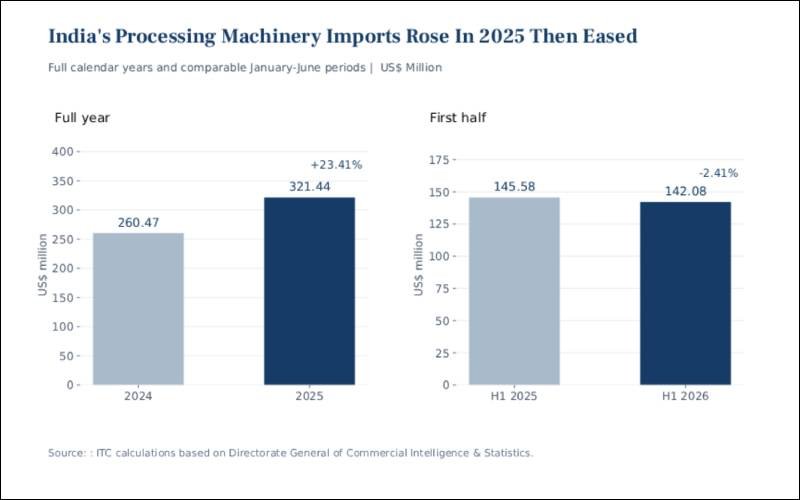
For a textile processor, a machinery purchase is a commitment to the orders the mill hopes to win tomorrow. India made that commitment more strongly in 2025, lifting imports of the selected processing machinery basket by 23.41% to US$ 321.44 million, from US$ 260.47 million in 2024. Yet the corresponding fabric export basket expanded by just 3.33%. The contrast raises a commercially important question: how effectively can investment in processing equipment translate into stronger export earnings?
The first half of 2026 offers a more cautious picture. Machinery imports slipped 2.41% year-on-year to US$ 142.08 million, while fabric exports fell 5.88% to US$ 1,840.21 million. These movements do not establish a direct relationship between equipment purchases and export sales. They do, however, place the industry’s investment decisions against a less forgiving export backdrop.
A strong year followed by consolidation
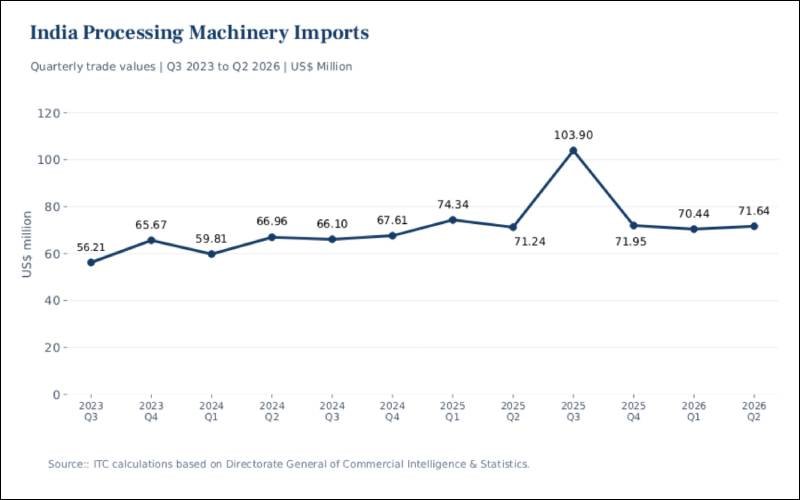
India’s machinery imports increased through much of 2025, reaching US$ 103.90 million in the third quarter, before retreating to US$ 71.95 million in the fourth. The third-quarter peak accounted for nearly a third of the year’s imports, underlining how individual delivery schedules can influence quarterly trade values.

Imports stood at US$ 70.44 million in the first quarter of 2026 and US$ 71.64 million in the second. The latest quarter was up 1.69% sequentially and 0.55% year-on-year. The overall picture is one of relatively steady purchasing after an unusually strong quarter, rather than evidence of an uninterrupted investment surge.
India also held up better than the global aggregate. Worldwide imports of the same machinery basket rose from US$ 4,893.24 million in 2024 to US$ 5,095.40 million in 2025, before declining 12.62% year on year to US$ 2,208.26 million in January–June 2026. India’s share consequently increased from 5.76% in the first half of 2025 to 6.43% a year later. It ranked second among the importing countries listed for the first half of 2026, behind the United States.
Dyeing equipment gains ground
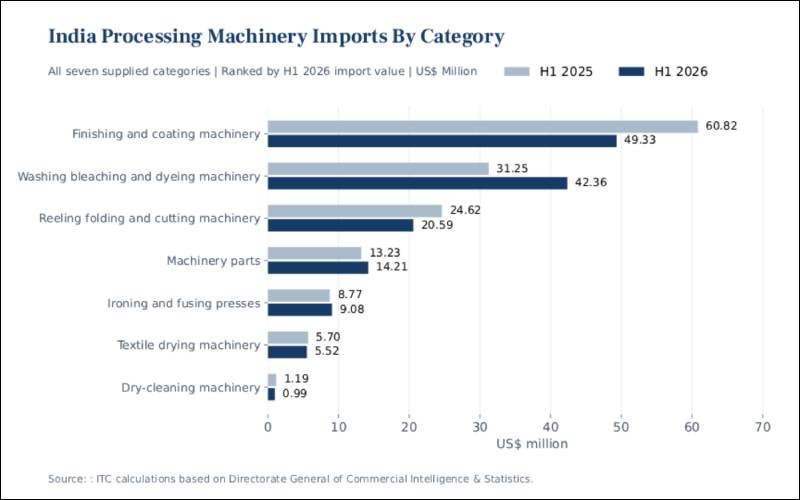
The most striking shift lies inside the machinery basket. Imports of washing, bleaching and dyeing machines under HS 845140 reached US$ 42.36 million in the first half of 2026, up 35.53% from US$ 31.25 million a year earlier. Second-quarter purchases jumped 76.69% year-on-year to US$ 25.08 million, making this the largest imported category in that quarter.
By comparison, dressing, finishing, coating and impregnating machinery under HS 845180 declined 18.89% to US$ 49.33 million in the first half. It nevertheless remained the largest category over the six-month period, following imports of US$ 120.16 million in 2025. Reeling, folding, cutting and related machinery fell 16.39% to US$ 20.59 million, while machinery parts increased 7.44% to US$ 14.21 million.
This divergence matters. A near-flat headline total conceals stronger buying in washing, bleaching and dyeing equipment alongside weaker purchases in several other categories. The figures show a change in the composition of imports; without machine specifications, quantities or mill-level evidence, they cannot establish whether that change represents capacity expansion, replacement or a particular technological upgrade.
Germany advances as China retains the lead
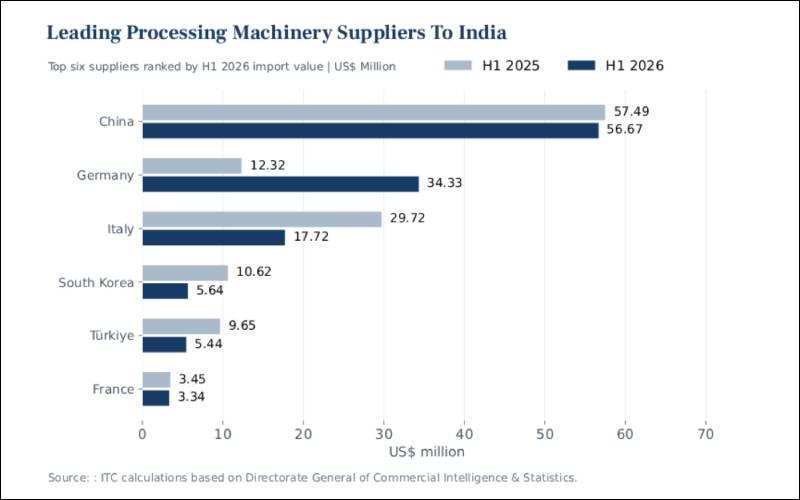
China remained India’s largest supplier in the consolidated country table, providing US$ 112.29 million of machinery in 2025 and US$ 56.67 million in the first half of 2026. Its six-month share was 39.88%, despite a 1.43% year-on-year decline in supplies.
Germany recorded a particularly sharp increase. Indian imports from Germany rose from US$ 12.32 million in January–June 2025 to US$ 34.33 million in the corresponding 2026 period, lifting its share to 24.16%. Second-quarter imports alone reached US$ 19.33 million, up 208.43% year-on-year. Italy, which supplied US$ 63.23 million in 2025, saw first-half shipments fall 40.39% to US$ 17.72 million.
Together, China, Germany and Italy supplied 76.51% of India’s first-half imports. That concentration makes supplier selection, delivery reliability, service support and the availability of spares practical considerations alongside the purchase price. The country data do not identify the technologies behind these shifts, so a change in supplier share should not be automatically read as a change in technological quality.
The return must come from the mill floor
The companion export analysis shows why the next stage deserves closer attention. India’s selected fabric exports increased from US$ 3,693.40 million in 2024 to US$ 3,816.45 million in 2025, but weakened in the first half of 2026. Higher machinery imports have therefore coincided with a much smaller increase in annual export receipts and, more recently, declining sales abroad.
Equipment installed in one period may support production in another, and machinery also serves domestic customers and products outside this export basket. No simple export-to-import ratio can measure its return. For processors, the useful questions are more specific: whether investment improves saleable output, reduces reprocessing, supports more demanding products or helps retain profitable orders.
India’s 2025 buying shows a willingness to invest. The challenge now is to make that investment commercially productive. As export demand becomes more selective, the strength of a processing operation will be judged through the fabric it delivers, the consistency it maintains and the business it can sustain.
Source: ITC calculations based on Directorate General of Commercial Intelligence & Statistics.
Disclaimer: Readers are requested to cross-verify the data before taking any decision.