
India’s Knitwear Export Challenge: Machinery Investment Surges, But Apparel Shipments Face Pressure

By Henry Dsouza
India’s knitting and allied machinery imports have surged, signaling a major investment cycle across the country’s textile manufacturing industry. But the export picture presents a more complex reality, while knitted fabric shipments have shown signs of recovery, exports of knitted apparel have come under pressure, highlighting the challenge of converting manufacturing investment into stronger international sales.
Trade data for the period from Q3 2024 to Q2 2026 shows that India exported knitted fabrics worth US$ 520.02 million in 2025, while knitted apparel exports reached nearly US$ 7898.96 million. The two segments, however, followed different trajectories in the latest quarter.

In Q2 2026, India’s knitted fabric exports increased 7.4% year-on-year to US$ 138.4 million. Knitted apparel exports, in contrast, declined 15.9% to US$ 1741.35 million in Q2 2026 from US$ 2069.58 million in Q2 2025.
The divergence raises an important question for the Indian textile industry: as manufacturers invest heavily in knitting and related machinery, what will it take to translate that investment into sustained export growth?
Machinery investment sets the stage
India’s knitting and allied machinery imports rose from approximately US$ 518.6 million in 2024 to US$ 877.5 million in 2025, an increase of nearly 69%. Imports amounted to a further US$ 423.2 million during the first half of 2026.
The scale of this investment is significant. India accounted for approximately 47.5% of global imports under HS 8447 in Q2 2026, according to the machinery dataset examined by Textile Insights. The category covers knitting machines, stitch-bonding machines and certain related textile machinery.
This investment suggests that manufacturers are strengthening production capabilities, upgrading technology and positioning themselves to respond to evolving demand.
However, machinery imports are an indicator of investment rather than a direct measure of production or export growth. The benefits depend on how efficiently new equipment is utilised, the products manufactured, access to raw materials, cost competitiveness and the ability to secure orders in international markets.
India’s knitted fabric and apparel export performance provides a useful starting point for assessing this wider picture.
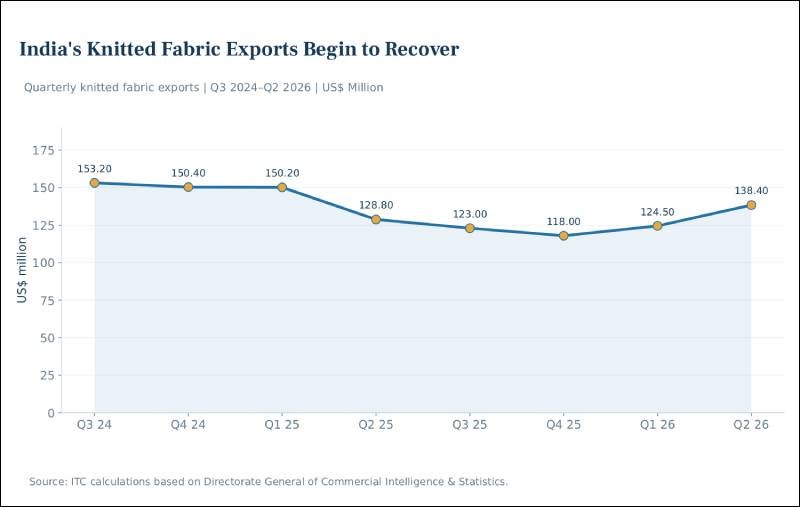
Knitted fabric exports recover in Q2 2026
India’s knitted fabric exports have faced pressure over the period covered by the data, but the latest quarter offers some encouragement.
Exports stood at US$ 153.2 million in Q3 2024 and US$ 150.4 million in Q4 2024. They remained at US$ 150.2 million in Q1 2025 before declining to US$ 128.8 million in Q2 2025.
The downward movement continued through the second half of 2025, with exports falling to US$ 123.0 million in Q3 and US$ 118.0 million in Q4.
The first half of 2026, however, showed a recovery. Exports increased to US$ 124.5 million in Q1 and further to US$ 138.4 million in Q2.
The latest quarterly figure represents growth of 11.2% over Q1 2026 and 7.4% over Q2 2025. Nevertheless, exports remained below the levels recorded during the second half of 2024.
For the full calendar year 2025, knitted fabric exports amounted to approximately US$ 520.0 million, based on the four quarterly figures in the dataset. During the first half of 2026, exports totalled US$ 262.9 million.
The recovery is a positive development, but its durability will become clearer in the subsequent quarters.
A concentrated market for Indian knitted fabrics
India’s knitted fabric exports are heavily concentrated in a small number of destination markets.
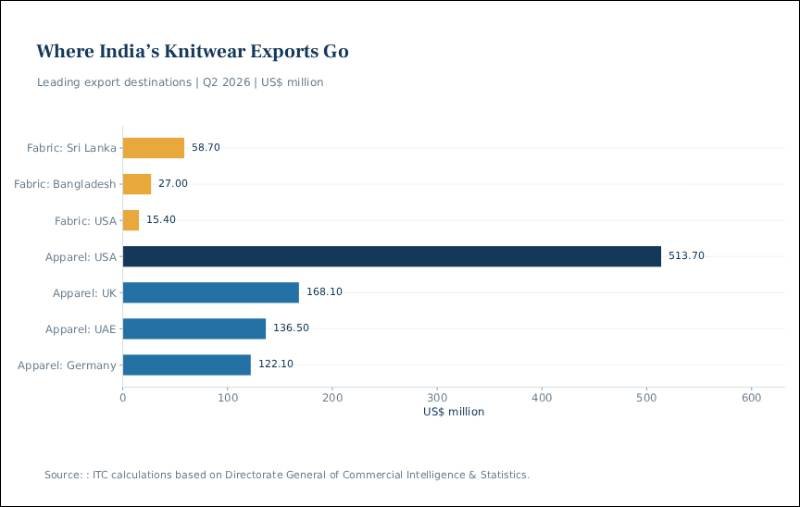
Sri Lanka was the largest destination in Q2 2026, accounting for US$ 58.7 million, approximately 42.4% of India’s knitted fabric exports. Bangladesh ranked second at US$ 27.0 million, representing 19.5%, while the United States accounted for US$ 15.4 million, 11.1%.
Together, these three markets absorbed nearly 73% of India’s knitted fabric exports during the quarter.
The destination-wise figures also reveal considerable differences in recent performance. Exports to Bangladesh increased 48.0% year-on-year in Q2 2026, while shipments to the United States rose 2.7%. Exports to Sri Lanka, however, declined 2.7%.
The United States market displayed a particularly sharp quarter-on-quarter recovery. Exports rose from US$ 7.3 million in Q1 2026 to US$ 15.4 million in Q2, although this followed a substantial decline during the second half of 2025.
The dependence on a few destinations creates both opportunities and vulnerabilities. Strong demand from Bangladesh and Sri Lanka can support Indian fabric manufacturers, particularly where regional apparel production requires reliable fabric supplies. At the same time, a slowdown or change in sourcing patterns in one major market can have a disproportionate effect on export performance.
Expanding into additional markets and strengthening relationships with international apparel manufacturers could help reduce this concentration.
Knitted apparel exports face a tougher environment
The knitted apparel segment presents a more challenging picture.
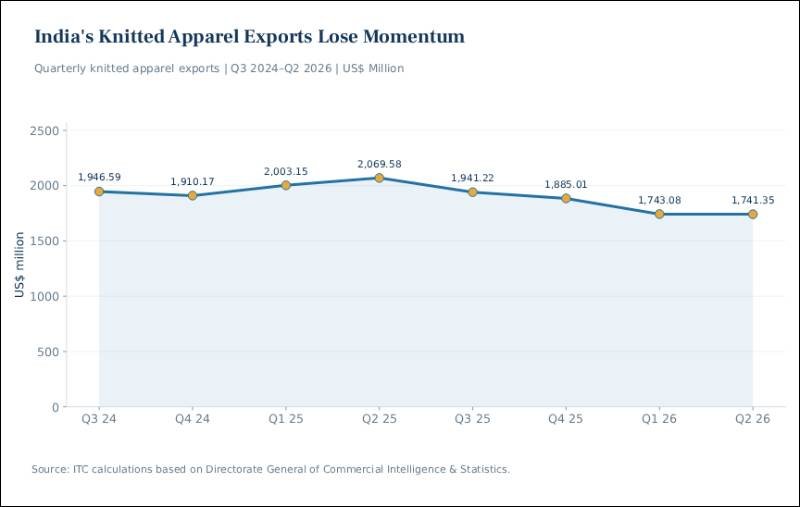
India’s knitted apparel exports reached US$ 1946.59 million in Q3 2024 and US$ 1910.17 million in Q4 2024. Exports increased to US$ 2003.15 million in Q1 2025 and peaked at US$ 2069.58 million in Q2 2025.
The market subsequently weakened. Exports declined to US$ 1941.22 million in Q3 2025 and US$ 1885.01 million in Q4 2025.
The decline continued into 2026, with exports falling to US$ 1743.08 million in Q1 and remaining almost unchanged at US$ 1741.35 million in Q2.
The Q2 2026 figure was down 15.9% year-on-year, representing a decline of approximately US$ 328.23 million from Q2 2025.
For calendar year 2025, India’s knitted apparel exports totalled approximately US$ 7898.96 million. First-half exports in 2026 amounted to US$ 3484.43 million.
The latest figures suggest that knitted apparel exports have yet to regain the levels achieved in early 2025. The difference between the fabric and apparel segments is notable, fabric exports have recovered on a year-on-year basis, whereas finished knitted apparel exports remain under significant pressure.
This divergence demonstrates why the two segments need to be analysed separately. Their customers, sourcing patterns, product mixes and competitive pressures are not identical.
The United States remains the largest apparel destination
The United States continued to be India’s largest destination for knitted apparel in Q2 2026, accounting for US$ 513.7 million, or approximately 29.5% of total exports.
The United Kingdom was the second-largest market at US$ 168.1 million, followed by the United Arab Emirates at US$ 136.5 million and Germany at US$ 122.1 million. The Netherlands, France and Spain were other important destinations.
Together, the United States and the United Kingdom accounted for approximately 39% of India’s knitted apparel exports in the quarter. Including the UAE and Germany takes the share of the four largest destinations to more than half.
However, the year-on-year figures show widespread pressure across several major markets.
Exports to the United States declined 28.5% in Q2 2026 compared with the corresponding quarter of 2025. Shipments to the UAE fell 19.3%, Germany declined 11.7%, the Netherlands fell 18.7%, France declined 10.5% and Spain fell 12.5%.
Saudi Arabia was a relative bright spot, with exports rising 24.5% year-on-year to US$ 55.0 million. Exports to Australia also increased by 5.6% to US$ 42.4 million.
These figures indicate that the weakness in India’s knitted apparel exports is not confined to one destination. Several of its established markets recorded lower shipments, although selected destinations continued to offer growth opportunities.
India’s position in the global market
India remains a significant participant in global knitted apparel trade, but it operates in a competitive environment dominated by established manufacturing and exporting countries.
In Q2 2026, India accounted for approximately 8% of global knitted apparel exports in the dataset. China remained the dominant exporter, with shipments valued at US$ 21503.13 million during the quarter, compared with India’s US$ 1741.35 million.
For knitted fabrics, India’s share was approximately 3% of global exports in Q2 2026. Global knitted fabric exports were valued at US$ 10239.36 million, with China accounting for US$ 7156.29 million, almost 70% of the total.
These figures underline the different positions occupied by India in the two segments. India has a more substantial presence in knitted apparel than in knitted fabric exports, while China dominates both categories, particularly knitted fabrics.
For India, the opportunity is not simply to increase export volumes. It is also to improve product differentiation, develop stronger buyer relationships, broaden its market reach and move towards products that offer greater value addition.
Will machinery investment translate into export growth?
India’s machinery imports and knitwear exports together present a mixed but important picture.
On the one hand, machinery imports surged in 2025 and remained substantial during the first half of 2026. Knitted fabric exports also recovered in Q2 2026, rising both quarter-on-quarter and year-on-year.
On the other hand, knitted apparel exports declined significantly compared with Q2 2025 and remained below their earlier levels.
The data does not establish a direct causal relationship between machinery imports and export performance. Newly imported machinery may take time to enter production, and the HS 8447 category includes equipment beyond conventional knitting machines. Export outcomes are also influenced by international demand, sourcing decisions, prices, product mix and competition.
Nevertheless, the contrast highlights a central challenge for India’s textile industry: investment in manufacturing capacity must ultimately be supported by sufficient demand and competitive export opportunities.
The next phase of growth will depend on whether manufacturers can use new machinery to improve productivity, strengthen quality, develop more value-added products and meet buyers’ requirements on cost and delivery.
India has demonstrated a strong appetite for knitting and related machinery. The next test is whether that investment can support a sustained expansion of knitted fabric and apparel exports. The recovery in knitted fabrics offers some encouragement, but the decline in knitted apparel exports shows that the conversion of investment into international sales remains a work-in-progress.
For the industry, the objective is clear: turn greater manufacturing capability into stronger market access, higher-value production and more resilient export growth.
Source: ITC calculations based on Directorate General of Commercial Intelligence & Statistics.
Disclaimer: Readers are requested to cross-verify the data before taking any decision.