

Inside the Box: How We Turned 5S Into A Geometry Exam

The VP shot me an accusatory glance.
I had just stood up to leave after an important technical discussion. His disapproving look conveyed to me what he was intending to say to me.
‘Don’t you dare leave that chair misaligned.’

I understood immediately.
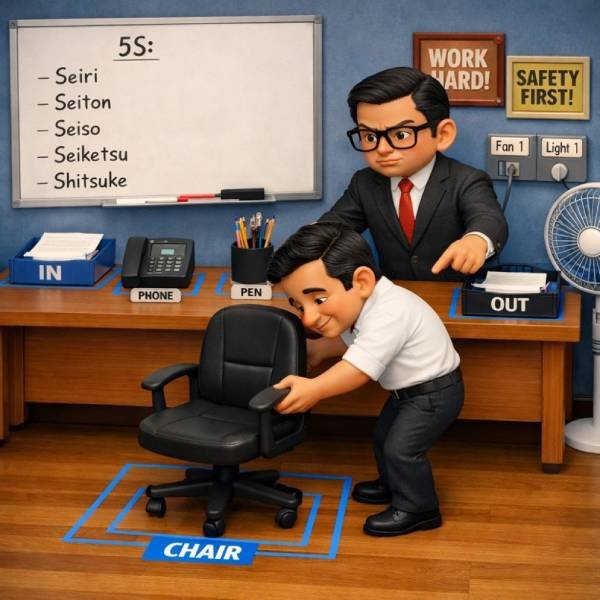
“Sorry!” I whispered and pushed the chair back so that all four legs sat perfectly inside the marking lines drawn on the floor — a rectangle that looked like a crime‑scene outline for murdered furniture.
The VP smiled, nodded and raised his thumb like a traffic cop signalling me to proceed — my chair was officially certified 5S‑compliant.
I felt as if I’d just escaped a grave situation — liberated by a thumbs‑up of mercy.
The Museum of Posters Nobody Reads
As I walked into the department, the walls greeted me with posters — motivational, colourful, inspirational… and completely ignored since the day they were pasted.
I carefully walked between the white lines on the floor, like a schoolboy afraid of stepping outside the hopscotch box.
The label on my door proudly declared:
“Factory Manager” (As if I might forget!)
Switchboard Archaeology
Inside my room, I searched the switchboard for the correct label.
There it was:
“Light No. 1”
I switched it on with the seriousness of launching a rocket.
Under the bright light, I inspected my table.
Everything was in its “official” position — except the IN‑tray, which had drifted 2 millimetres outside its sacred boundary.
I cursed the office boy and nudged it back into its holy rectangle.
Then I sat down and checked my emails.
I had increased the font size earlier because I didn’t dare pull the monitor closer — that would shift it outside its marking, and then I would have to answer to the VP’s laser eyes again.
The Japanese Visitor
A notification popped up:
“11 AM: Visit of Japanese customer Hyodo‑san (ladies’ inner garments manufacturer).”
“Great,” I muttered.
“Another test of our… geometry skills.”
I rushed out to inspect the departments.
Everything was in place — or at least inside a box.
At 11 AM sharp, Hyodo‑san arrived.
After the welcome and the mill tour, we gathered in the meeting hall.
The VP asked proudly,
“So, sir… how was the mill? Any suggestions?”
Hyodo‑san smiled politely.
“I appreciate that you have implemented 5S — the Japanese way of housekeeping.”
The VP beamed.
He even threw me a look that said,
“Your increment is safe.”
Then Hyodo‑san continued.
“However… this is an Indian style of over‑interpretation of 5S.”
The VP’s smile froze.
My increment evaporated.
 The Truth Bomb
Seeing our disappointment, Hyodo‑san hesitated, then gently explained:
“People think more labels mean more discipline.
But authentic Japanese 5S is subtle, human‑centred, and almost invisible.”
We stared at him blankly.
‘We had done exactly what our 5S trainer told us to do. We had spent hours marking, taping, labelling, and aligning things that never needed alignment in the first place.’
Hyodo‑san walked to the whiteboard and wrote:
Japanese 5S = culture + habit + ownership
Indian 5S = markings + labels + cosmetic order
Then he explained:
“5S is about mindset, not stickers.
It is meant to make work easier, reduce waste, improve flow, and build pride.
Not to turn a factory into a kindergarten classroom full of labels.”
I wanted to tell him,
“Sir, unless we over‑interpret, nobody here will follow anything.”
But I kept quiet.
Hyodo‑san continued:
“In real Japanese factories, you will NOT see ‘Fan 1’, ‘Fan 2’, ‘Light 3’, outlines for phones and staplers, tape around table legs, excessive colour coding, or labels on obvious things. If something is obvious, don’t label it. If people are trained well, they don’t need reminders everywhere. If a system needs too many markings, the system is weak.”
We all looked at each other.
‘We had done every single thing he listed.’
He added:
“When you overdo markings, it creates visual clutter, loss of seriousness, and employees feel treated like children. 5S becomes a photo opportunity, not a culture change.”
The VP swallowed hard.
“So… you suggest we should not do any marking?”
Hyodo‑san smiled.
“Do markings only when necessary — to avoid confusion, when many people share the same space, when items are often misplaced, or when safety is involved. For example, tool shadow boards, forklift pathways, chemical zones, and emergency equipment. These are functional, not decorative.
The Japanese principle is ‘必要なものだけ’ — Only what is necessary.
If a marking does not improve safety, speed, or reduce mistakes… it is a waste.”
Then he delivered the final blow:
“Excessive markings violate the first S — Seiri (Sort) —
because you are adding unnecessary items.”
We sat silently, remembering all the ridiculous things we had done to keep objects inside their sacred rectangles.
That day, we learned something important:
We had implemented 5S with enthusiasm…but without understanding.
And sometimes, the funniest part of 5S is not the system — but the way we Indians over‑interpret it.
(Murugan Santhanam is Managing Director of Texdoc Online Solution Pvt. Ltd.)