Is It Time To Rediscover SAARC?
What is SAARC
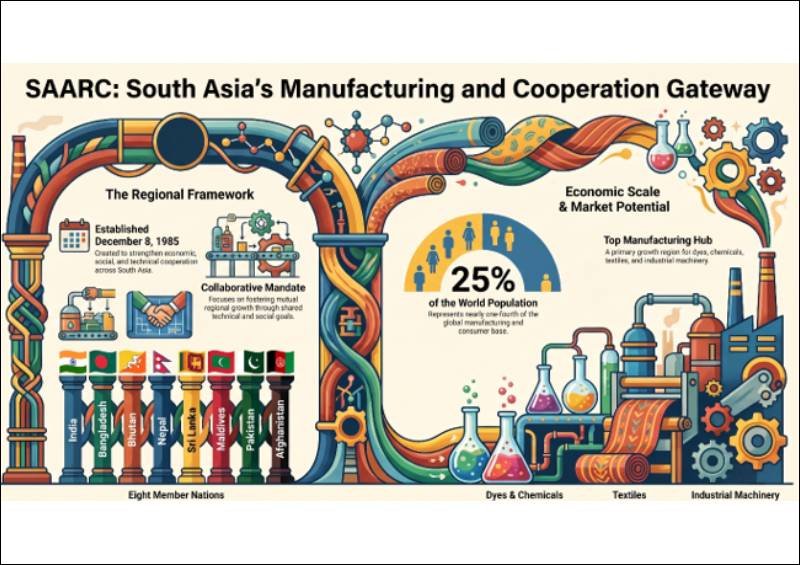
South Asia is often discussed through the lens of politics, yet for manufacturers of dyes, chemicals, textiles and textile machinery it represents one of the most promising regional business opportunities in the world. The South Asian Association for Regional Cooperation (SAARC), established on December 8, 1985, was created to strengthen economic, social and technical cooperation among India, Bangladesh, Bhutan, Nepal, Sri Lanka, Maldives, Pakistan and later Afghanistan. Together these nations represent nearly one-fourth of the world’s population and a vast manufacturing and consumer base.
When SAARC was formed, India strongly supported regional economic integration. The expectation was that neighbouring countries would benefit from easier trade, better connectivity, technology exchange and industrial cooperation. The South Asian Free Trade Area (SAFTA), implemented in 2006, was an important milestone towards reducing tariffs and promoting intra-regional trade. Although the pace of integration has not matched the success of ASEAN or the European Union, the business logic behind regional cooperation remains relevant.
For the textile value chain, South Asia is unique. India has one of the world’s most diversified textile industries, Bangladesh is among the largest garment exporters, Sri Lanka is recognised for premium apparel, Pakistan has a strong cotton and weaving base, while Nepal and Bhutan continue to develop niche textile manufacturing. Every one of these industries depends on dyes, pigments, textile auxiliaries, finishing chemicals, laboratory equipment and textile machinery.

Has Exporting Become More Difficult Than Before?
According to the Government of India, the textile and apparel sector remains one of the country’s largest employers and export earners. Recent releases from Ministry of Textiles indicate exports of textiles and apparel remain above ₹3 lakh crore annually despite global headwinds. However, the business environment has changed significantly. Buyers now expect sustainability, rapid deliveries, traceability, competitive pricing and compliance with standards such as ZDHC, GOTS and OEKO‑TEX. Freight volatility, energy costs and intense global competition continue to pressure manufacturers.
In this environment, regional markets become strategically important. Shorter transit times reduce logistics costs. Technical service can be provided quickly. Similar cotton processing practices across South Asia reduce product adaptation. Stronger regional supply chains can improve resilience at a time when global disruptions have become frequent.

Dr. Bharat Trivedi, Sr. Manager-Exports & Imports, Colorant Limited
Why has India’s focus on SAARC reduced?
Over the years, several regional initiatives progressed slowly because consensus among all members proved difficult. Consequently, India increased engagement through BIMSTEC and bilateral partnerships. This policy shift does not diminish the commercial importance of neighbouring markets. Businesses evaluate opportunities based on customer demand, profitability, logistics and long-term relationships rather than diplomatic timelines.
Country-wise opportunities remain significant. Bangladesh continues to import large volumes of reactive dyes, auxiliaries and textile chemicals for its export-oriented garment sector. Sri Lanka values sustainable and technically advanced products for premium apparel. Nepal and Bhutan depend heavily on imported industrial chemicals and machinery. Maldives requires textiles and specialty products for its hospitality industry. Even where markets are smaller, proximity and ease of service create competitive advantages for Indian suppliers.
At Colorant Limited, we believe that exports are built on partnerships rather than transactions. Over the years, our interaction with textile processors has shown that customers increasingly seek solution providers capable of offering product consistency, application support and sustainability. Through the COLRON range of reactive dyes and our commitment to internationally recognised standards including ZDHC MRSL Level 3, GOTS and OEKO‑TEX ECO PASSPORT, we strive to support customers in meeting the evolving requirements of global brands. Investments in manufacturing and R&D reflect our confidence that South Asia will continue to play an important role in the future of the textile industry.
What are the opportunities?
The opportunities are not limited to dyes. Textile machinery manufacturers, testing equipment suppliers, automation providers and environmental technology companies can all benefit from stronger regional cooperation. Faster commissioning, after-sales service and technical training are easier to provide within neighbouring countries than across distant continents.
Looking ahead, Indian companies should build distributor networks, participate in regional exhibitions, organise technical seminars, collaborate with universities and strengthen local service capabilities. Regional business should not be viewed as an alternative to global exports but as a complementary growth strategy that enhances competitiveness.
Nearly four decades after SAARC’s formation, the vision of regional prosperity deserves renewed attention. Governments will continue to shape policy, but industry has the ability to build commercial bridges through innovation, trust and collaboration. For India’s dyes, chemicals, textile and textile machinery sectors, South Asia is more than a geographical neighborhood — it is a natural market connected by shared manufacturing traditions, similar processing technologies and common aspirations for sustainable growth.
At Colorant Limited, we believe the future of the South Asian textile industry lies in cooperation, technology and responsible chemistry. Companies that invest today in regional relationships, sustainable products and technical excellence will be best positioned for tomorrow’s opportunities. Perhaps the question is no longer whether SAARC has achieved all that was envisioned in 1985. The more important question is whether Indian industry is ready to rediscover the immense potential that exists just beyond its borders.
Conclusion
SAARC is much more than a political organization — it represents one of the world’s largest untapped regional business opportunities. While political discussions often dominate headlines, the manufacturing community should focus on the long-term economic potential of South Asia.
For the dyes, chemicals, textile, and textile machinery industries, regional cooperation can lead to higher trade volumes, lower logistics costs, faster deliveries, stronger supply chains, and enhanced global competitiveness.
As the global textile industry continues to shift toward sustainability, compliance, and resilient sourcing, South Asia has the opportunity to emerge as an integrated manufacturing powerhouse. Businesses that begin strengthening their presence across SAARC markets today will be better positioned to benefit from the region’s future growth.