Dunguripali And The Next Economy Of Sambalpuri Ikat
The Bandha may be tied and dyed, but its future need not remain tied down. Sambalpuri Ikat has already mastered the art of holding its colours, it must now learn to spread its wings.
Sambalpuri Ikat has never lacked identity. Its colours, motifs and Bandha technique (tie and dye) carry generations of knowledge. Yet cultural recognition does not automatically provide livelihood security. A textile may be admired nationally while the household producing it continues to face irregular work, uncertain wages, expensive inputs and delayed payments.
Odisha has approximately 63,223 handloom households, with around 53,472 weavers and 64,364 allied workers, nearly 1.18 lakh people dependent on the sector. Bargarh and Subarnapur form its most concentrated western handloom belt.

Subarnapur has around 6.10 lakh people living across six blocks, 109-gram panchayats and 962 villages. Dunguripali block alone contains 21 gram panchayats and 112 revenue villages. This geography matters. Sambalpuri Ikat is not produced within one organised factory. Production is distributed among household looms, Bandha workers, dyers, master weavers, primary societies and small production groups.
The challenge is therefore not simply to create new designs. It is to coordinate this dispersed production system around new and dependable markets. A 2025 study of 60 handloom households in Sonepur block reported an average income of ₹15,248.33. More than half the respondents were dissatisfied with the prevailing wage-determination system. The study also observed continued dependence on traditional looms and master-weaver-led arrangements.
Dunguripali Bunakara Producer Company Ltd (DBPCL), established in 2019, describes its purpose as producing and marketing quality handloom fabrics through members, affiliated societies and production agents. It reports working with more than 50 affiliated primary handloom societies, as maintained by its founder Pradeep Mahapatra, appears to have recognised the missing institutional layer between the household loom and the larger market. However, it indicates the potential size of the platform as an illustrative example.
Weavers possess the technique, and societies can organise local production. However, they may not individually have the resources to undertake market research, product development, technical sampling, quality assurance, digital promotion and negotiation with institutional buyers. A producer company can potentially bring these functions together.
The saree must remain the cultural and commercial anchor of Sambalpuri Bandha. Diversification should build around it, not replace it. The first opportunity is B2B fabric. Designers, exporters and apparel manufacturers require curated yardage supported by swatch codes, yarn composition, fabric width, motif repeat, colourway, intended application, minimum quantity and lead time.
The second is contemporary apparel. Sambalpuri Ikat can be developed for men’s shirts, overshirts, jackets and waistcoats, as well as women’s dresses, tunics, wraps and resort wear. This requires apparel-compatible fabric, smaller motifs, coordinated colourways and planned pattern placement.
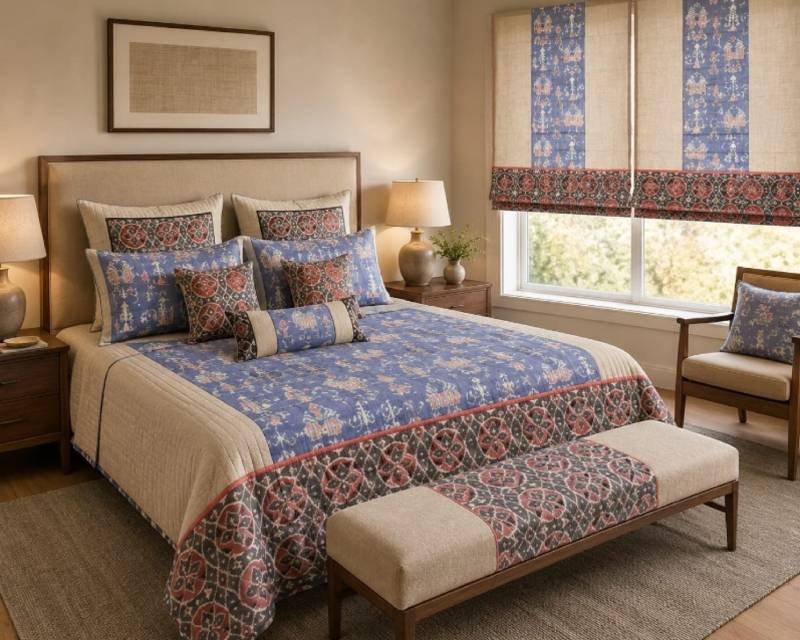
Hospitality presents another opportunity. Hotels and resorts increasingly seek textiles that provide a sense of place. Ikat can be selectively introduced through cushions, runners, bed accents, blinds, wall panels and throws. However, hospitality buyers require standard dimensions, colourfastness, shrinkage control, wash performance, packing and repeat-order capability.
Accessories and products made from cutting and weaving remnants may create additional value. But circularity should not become a convenient marketing label. Remnants must be systematically segregated, documented and converted through a defined design process.
The GI registration itself supports diversification. The registered name is “Sambalpuri Bandha Saree & Fabrics,” covering Classes 24 and 25, and is recorded as valid until July 2030. This provides a legitimate foundation for fabric and apparel development while protecting the defined geography and technique.
GI protection must now become commercially useful. Buyers should be able to distinguish authentic handwoven Bandha from printed or power loom imitation. A traceability system could connect each product to its weaver or production group, society, swatch, material and batch.
Technology can assist with loom mapping, dye-lot records, production scheduling, quality documentation and digital catalogues. AI may support colourway visualisation and buyer-brief interpretation. It should organise the handmade process, not imitate or replace it.
Bottomline is, growth must reach the loom. Sambalpuri Ikat’s progress should be measured through active weavers receiving orders, annual working days, remuneration, sampling payments, payment periods, women’s participation, entry of younger people and repeat B2B business.
Sambalpuri Ikat does not require reinvention. It requires a better-organised economic life. Let the Bandha travel from the saree to apparel, hospitality and contemporary interiors. That alone will make diversification meaningful.
The future should not leave the weaver in a tight spot simply because the yarn is tightly tied. Let the Bandha travel farther and ensure that prosperity finds its way back to the loom.
(Rony Banerjee is a strategy and policy advisor working at the intersection of textiles, MSMEs, sustainability and public policy.)