
Locked In A Hot Room: How I Finally Understood Enthalpy!
Upon entering the air‑conditioning specialist’s office, I was greeted by a refreshing coolness — the kind that feels like a gentle sea breeze. Just moments earlier, I had been thinking about how the weather outside had suddenly shifted from pleasant to unbearably hot over the past week.
The specialist welcomed me and offered a seat. As I settled down, I instinctively looked around the room, trying to locate the source of that “sea breeze.”
He noticed my curiosity, smiled and pointed to an air cooler tucked beneath the window.
After returning to his chair, he said, “Most of the time, I prefer using an air cooler instead of an AC. It saves power, and it also gives a bit of humidity — which is actually better for healthy breathing.”
I mentally bookmarked that “healthy breathing” comment for later. My main purpose that day was to understand adiabatic cooling more clearly.
“So, I trust you have no doubts about entropy now?” he asked.
“I understand as much as a textile professional needs to, sir,” I replied.
He smiled again, stood up, and began closing the windows and doors.
I assumed he was doing this to reduce the energy loss from the air cooler.
“Alright,” he said, “let’s talk about enthalpy. And as usual, I believe you don’t want equations or fancy jargon, right?”
“It’s not that I hate equations,” I protested, “but as a textile person, they’re difficult for me to understand.”
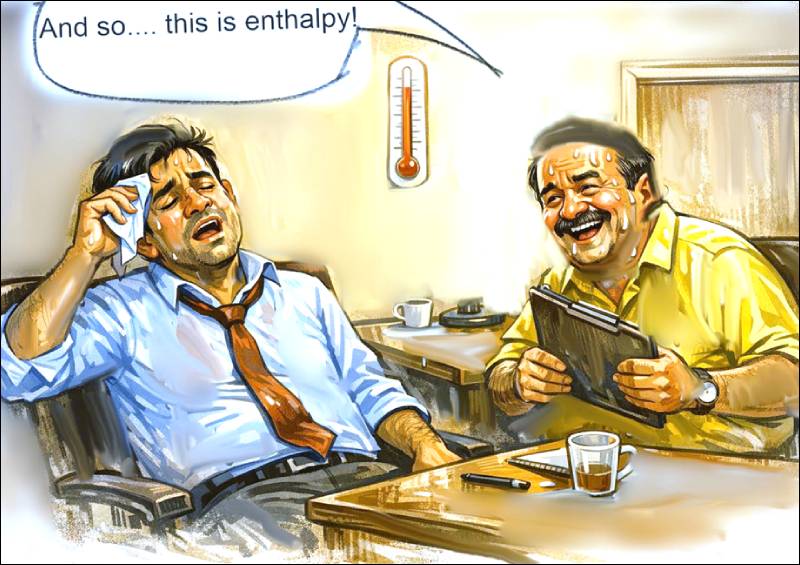
By then, the room had begun to feel slightly uncomfortable. The air felt heavier. Within minutes, both of us were sweating.
“What happened suddenly? We’re sweating like anything! Did you turn off the AC?” I asked.
He laughed. “Just wait a moment.”
The room grew hotter and more suffocating. I felt like I was inside an oven. Breathing became difficult — like a fish out of water. ‘Is this the ‘healthy breathing’ he mentioned?’- I wondered.
Unable to bear the sultriness any longer, I finally asked, “Sir… can we please step outside for a minute?”
“No need! Outside is even worse. Just wait.”
He quickly opened the windows and doors, then switched off the pump of the cooler while letting the fan run.
Within moments, the room returned to a pleasant, breathable state. I exhaled in relief.
“I’m sorry,” he said with a mischievous grin. “That was a practical demonstration of enthalpy — without equations, jargon, or fancy words!”
I stared at him, confused. “But what exactly was enthalpy in all this? The heat? The humidity? The sweating?”
He leaned forward.
“Let me explain. Our body sweats to maintain temperature. When sweat evaporates, it takes heat from our skin — so we feel cool. But the total heat in our body, the sweat, and the surrounding air doesn’t disappear. It only moves. Enthalpy is simply the total heat carried by air — the heat in the air itself plus the hidden heat carried by water vapour. Dry air carries less heat. Humid air carries more because water vapour contains latent heat. That latent heat is part of enthalpy.”
He looked pleased with his explanation. But his words opened more questions in my mind.
“So… are we controlling the temperature of the air?” I asked.
“No!” he said,” When we spray water into the air, the water evaporates by stealing heat from the air. So, the air becomes cooler but more humid. The total heat — the enthalpy — stays the same. It only changes form. That is adiabatic humidification. Temperature alone cannot describe this process. Two air samples may have the same temperature but different moisture levels — and therefore different heat content. Enthalpy captures both temperature and moisture in one number.”
I nodded slowly. “Then why did we feel so much heat when you closed the room?”
“That,” he said, “is the second part of the adiabatic story. In the first part, water steals sensible heat from the air and becomes vapour. That gives us cool, moist supply air. In our little experiment, we created similar supply air — and then kept recirculating it inside a closed room. As the air kept circulating, it picked up additional heat from our bodies, from the pump and fan motors, and from the natural friction of air molecules. So the temperature and enthalpy increased. And because the pump was running continuously, the humidity also increased. The air became nearly saturated.”
He paused to let it sink in.
“Now imagine what happens to us in such air. With more heat, we sweat more. But because the air is already full of moisture, our sweat cannot evaporate easily. So we feel hotter, stickier, and extremely uncomfortable.”
“Yes,” I said, “now I understand why you opened the windows — to remove the extra heat.”
“Exactly. Now think of the air in a spinning mill. The air from the humidification plant enters with a defined dry‑bulb temperature, RH, and enthalpy. Inside the department, motors, spindles, drafting friction, lights, and people add sensible heat. The air temperature and enthalpy rise. If the air is more humid than the fibre, the fibre absorbs moisture. By the time the air returns to the plant, its dry‑bulb temperature is higher and its humidity ratio slightly changed. This air must be let out, or else the department becomes uncomfortable — just like our room.”
He finished the explanation in one breath.
I thanked him and stepped out, carrying with me a clearer understanding of enthalpy — not from equations, but from experience.
(Murugan Santhanam is Managing Director of Texdoc Online Solution Pvt. Ltd.)