
The Future Of Cotton In India Is Living Soil: Dr Ajay Ranka

Dr. Ajay Ranka believes the future of Indian cotton lies in restoring soil health, reducing chemical dependence and creating a profitable transition to bio-based farming.
For Dr. Ajay Ranka, the future of Indian cotton farming will depend on one fundamental question: can the country improve soil health while making farming more profitable for the farmer?
He believes the answer is ‘yes’!

Speaking about the company’s approach to bio-based farming, Ranka says India has reached a critical point in its cotton journey. Cotton production is under pressure, soil fertility is declining, water tables are depleting and input costs continue to rise. At the same time, global competition is intensifying.
“We are talking about profitability for the farmer from the first crop cycle. We are talking about chemical-free farming and converting to bio-practices without compromising yields,” he says.
The challenges facing Indian cotton
According to Ranka, the decline in soil organic carbon is one of the biggest challenges confronting Indian agriculture. In many areas, organic carbon levels have fallen sharply, affecting soil fertility and productivity.
Water availability is another major concern. Cotton is a water-intensive crop, while groundwater levels are declining in several cotton-growing regions.
The growing pressure from pests and diseases has also led to increased dependence on chemical inputs. “We are starting to use very high amounts of chemical fertilisers, particularly nitrates and ammonium, which act like a magnet for attracting pests and disease-causing pathogens,” Ranka explains.
Over the past 25 years, the costs of fertilisers, pesticides and other agricultural inputs have continued to rise, putting further pressure on farmer profitability.
At the same time, global competition has intensified, with countries such as Brazil emerging as major cotton producers and putting pressure on international prices.
“Cotton farming and pricing in India is just not viable when it comes to international pricing pressure. We are not competitive,” he says.
Making the transition profitable
The transition to organic and chemical-free farming has traditionally been difficult for farmers. A conventional organic transition can take several years, during which farmers may face lower yields and higher costs.
This is where Zydex has developed its Prakalp Sanjeevani protocol, which aims to restore soil health while making the transition economically viable from the first crop cycle.
According to Ranka, the technology is designed to improve soil structure, increase porosity, improve water-holding capacity and enhance soil biology. “We can enhance soil fertility within one month. That’s the breakthrough. Profitability from the first crop cycle is a breakthrough,” he says.
The approach uses polymer-based bio-fertiliser technology to transform compacted soil into a softer and more porous medium. This allows better gas exchange, improved water infiltration and stronger root development. The objective is to create a healthier root zone where plants can access water and nutrients more effectively.
Restoring soil biology
A key part of the approach is the biological treatment of organic resources such as cow dung, buffalo dung, poultry manure and farm residues.
Prakalp Sanjeevani Protocol aims to improve the quality of bio-digested manure and create a biologically active, fungus-dominated environment. Ranka believes this can significantly reduce the volume of manure required for application while improving its effectiveness.
The approach also focuses on improving water infiltration. With more porous soil, rainwater can penetrate the ground more efficiently, potentially helping to replenish groundwater levels and reduce waterlogging.
According to Ranka, field experience has shown that water tables have increased by three to six feet per year in some areas where the approach has been adopted.
Improving cotton quality
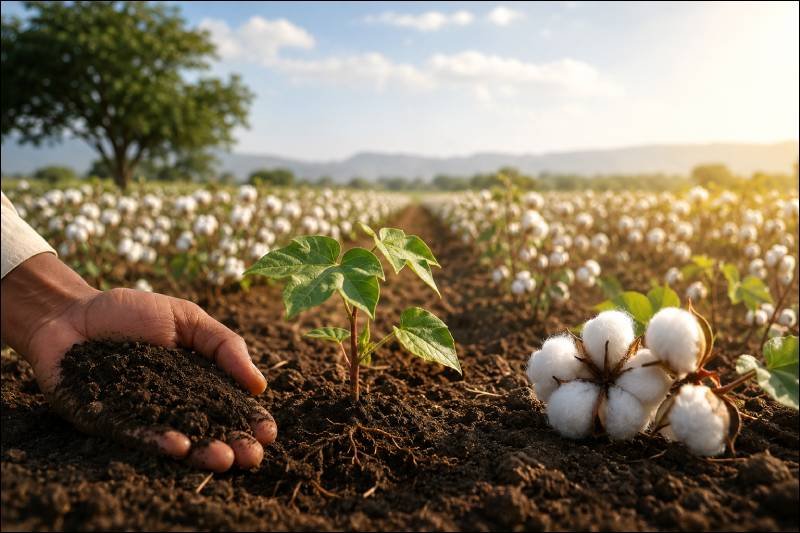
The benefits, he says, extend beyond yield and soil health. Field trials in cotton-growing regions, including Haryana and tribal areas of Gujarat, have shown improved production without the use of chemical inputs.
Zydex has also evaluated the impact of the approach on cotton quality. According to Ranka, cotton produced under the Prakalp Sanjeevani protocol has performed strongly against parameters associated with Kasturi cotton, including fibre length and strength.
The underlying logic, he says, is straightforward — a healthier plant with a stronger root system is better equipped to produce higher-quality fibre.
A role for the textile industry
Ranka believes the textile industry can play a much larger role in transforming cotton farming. He proposes the creation of demonstration farms in cotton-growing villages, supported by textile companies and technical experts.
Ranka’s vision is to establish progressive farmers who can demonstrate the approach, while agronomists help educate and guide other farmers. “Farmers do not listen. They observe,” he says.
For textile companies dependent on cotton sourcing, this could create a direct link between the field and the fashion supply chain.
Ranka has even offered to conduct large-scale demonstrations and guarantee profitability in selected plots, with Zydex taking responsibility for any losses. “This is my contribution for my India,” he says.
The future is living soil
Ranka believes the future of Indian cotton cannot be built on increasing chemical dependence.
The objective, he says, should be to restore soil biology, improve water efficiency, reduce chemical inputs and create a more profitable farming system.
India’s Participatory Guarantee System also offers farmers a lower-cost pathway towards organic certification, potentially making the transition more accessible.
“To me, the future of cotton is living soil,” Ranka says.
For India, the concept of farm-to-fashion could therefore evolve beyond a supply-chain idea. It could become a model in which the textile industry actively supports healthier soils, stronger farmers and more sustainable raw material production.
The challenge now is to move from individual demonstrations to large-scale adoption. If the textile industry, technology providers and farmers work together, the future of Indian cotton may not only be more sustainable, it could also be more profitable.