West Asia Crisis Tests India’s Textile Sector Resilience
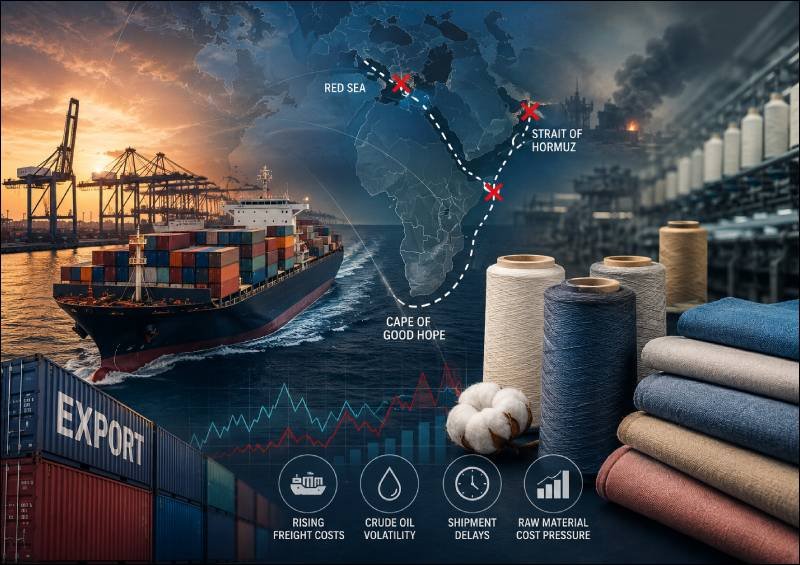
India’s textile and apparel industry is facing one of its most complex operating environments in recent years as the escalating crisis in West Asia disrupts shipping routes, inflates freight and insurance costs, delays export deliveries and increases volatility in crude-linked raw materials. For a sector already battling uneven global demand, tariff-related uncertainties and fluctuating cotton prices, the geopolitical turmoil has added a fresh layer of operational and financial stress.
The impact is particularly significant because textiles remain among India’s largest export-oriented and employment-intensive industries. India exports textile and apparel products worth over $35 billion annually, with key markets including the US, Europe and the Gulf region. Much of this trade depends on maritime routes passing through the Red Sea and the Strait of Hormuz — areas that have witnessed severe disruptions amid the ongoing conflict.
“India’s textile industry, one of the country’s largest employment generators, is witnessing mounting stress from delayed shipments, rising polyester and logistics costs, elongated payment cycles and export uncertainties in Gulf-linked markets. While the industry has demonstrated resilience through multiple economic disruptions in recent years, the current crisis reinforces the urgent need for diversification of markets, improved liquidity support and stronger raw material security,” says Primus Partners in its recently released Sectoral Point of View report, `Impact of the West Asia Crisis on Indian Sectors’, highlighting how the ongoing geopolitical instability in West Asia is creating deep structural challenges as well as strategic opportunities for the Indian economy across sectors.

Industry executives and analysts say the crisis is no longer being viewed as a temporary disruption. Instead, textile companies are increasingly treating it as a structural challenge that could reshape sourcing patterns, logistics planning and export strategies for the next several years.

Rajeev Gupta, Joint Managing Director, RSWM Ltd.
“The recent geopolitical tensions in West Asia have created challenges for the textile industry through higher freight costs, volatility in crude-linked raw materials and delays across key global trade routes. Since a significant share of India’s textile exports moves through western shipping corridors, the sector is closely monitoring logistics and supply-chain developments. However, the industry today is far more resilient and operationally agile, with companies increasingly focusing on efficiency, supply-chain diversification and value-added manufacturing to navigate such disruptions,” says Rajeev Gupta, Joint Managing Director, RSWM Ltd.
According to industry estimates, freight rates on some routes linked to West Asia and Europe have surged sharply as shipping companies divert vessels through the Cape of Good Hope to avoid conflict-prone regions. Transit times for shipments to Europe and North America have increased by nearly three to four weeks in many cases, creating serious complications for fashion-oriented exports where timely delivery is critical.
The Indian textile sector is especially vulnerable because of its dependence on global supply chains and imported petrochemical-linked inputs. Rising crude oil prices triggered by the geopolitical conflict have increased the cost of polyester fibres, dyes, chemicals and synthetic yarns. This has placed additional pressure on margins, particularly in the manmade fibre (MMF) segment.
The industry assessment notes that freight charges for certain West Asia-bound cargo routes have risen dramatically, while shipment timelines have become unpredictable. Industry bodies have warned that the combination of logistics inflation and raw material cost escalation could weaken the competitiveness of Indian exporters at a time when global buyers remain cautious.
The crisis has also coincided with a sharp rise in domestic cotton prices and tightening raw material availability. In a bid to cool down cotton prices, the government has now temporarily removed the 11 per cent import duty on cotton from June 1 to October 31, 2026. The industry bodies have welcomed this move, even as Confederation of Indian Textile Industry (CITI) stated that India’s cotton production is expected to remain below consumption levels, creating supply concerns for spinning mills and garment manufacturers. Exporters argue that higher cotton prices and rising logistics costs have been eroding India’s competitiveness compared to countries such as Bangladesh and Vietnam, which enjoy duty-free cotton access.
Several listed textile companies have openly acknowledged these challenges during their recent earnings calls with analysts.
Among the affected has been Welspun Living, which linked weaker quarterly profitability to higher freight costs, geopolitical uncertainty and cautious global demand. The company stated that retailers in the US and Europe were maintaining conservative inventory positions because of uncertainty around global shipping routes. Welspun management also indicated that shipment planning cycles were being recalibrated to account for longer transit periods and elevated logistics expenses.
Similarly, Arvind Ltd has highlighted the need for stronger inventory management and diversified sourcing strategies. During analyst interactions, the company indicated that it was maintaining larger raw material buffers and closely tracking shipping schedules to avoid production disruptions. Arvind is also exploring alternate transhipment hubs and multimodal logistics options to reduce dependence on vulnerable maritime routes.
At the same time, the company is increasing its focus on value-added and technical textiles to reduce exposure to commoditised segments that are highly vulnerable to freight and pricing shocks. Analysts believe diversification into advanced materials and branded apparel could help cushion volatility in traditional export businesses.
Vardhman Textiles has also raised concerns over cotton availability, elevated logistics costs and forex volatility. The company noted during its earnings discussions that foreign exchange losses and higher freight expenses had affected profitability, although it remained optimistic about long-term export demand recovery.
“At RSWM, our focus remains on strengthening sustainable and integrated operations, alongside greater emphasis on operational efficiency, supply-chain planning and higher utilisation of renewable energy within our manufacturing ecosystem to mitigate cost volatility. Importantly, despite global uncertainties, India’s textile and apparel sector recorded exports worth $37.7 billion in FY25, reflecting the industry’s underlying resilience and global competitiveness. We believe the ongoing China+1 sourcing shift and growing preference for reliable, sustainable suppliers will continue to create long-term growth opportunities for the Indian textile industry,” states Gupta.
Meanwhile, KPR Mill has focused on operational resilience and integrated manufacturing strengths. The company believes India continues to benefit from the global “China+1” sourcing strategy, with international buyers seeking more diversified and politically stable supply chains. KPR Mill indicated that its integrated operations and domestic cotton sourcing network were helping reduce exposure to external disruptions.
Surat, one of India’s largest synthetic textile hubs, has emerged among the worst-hit clusters. Industry associations in the region have warned that yarn and synthetic raw material prices could rise significantly because of higher crude prices, shipment delays and insurance costs. Businesses dependent on Gulf-linked trade routes are also facing concerns over payment security and delayed receivables.
To deal with these challenges, Indian textile companies are increasingly adopting a multi-pronged mitigation strategy.
One of the key responses has been supply-chain diversification. Exporters are expanding their focus beyond traditional markets in Europe and West Asia and targeting Latin America, Africa and ASEAN countries. Industry experts believe this diversification could become a long-term structural shift rather than a short-term response.
Companies are also redesigning logistics strategies. Many exporters in textile clusters such as Tiruppur and Surat are advancing shipment schedules to avoid bottlenecks and ensure timely delivery of seasonal orders. Some firms are increasing inventory buffers and maintaining finished goods closer to destination markets through regional warehousing models.
There is also greater use of multimodal transport and selective air freight for urgent consignments despite higher transportation costs. Exporters are simultaneously renegotiating delivery schedules with international buyers to avoid penalties linked to shipment delays.
Another important strategy is increased focus on domestic demand. India’s growing apparel and fashion market is acting as a stabilising factor amid global uncertainty. Many textile manufacturers are balancing export exposure with deeper penetration into domestic retail and technical textile segments.
Industry observers believe the crisis may eventually accelerate structural transformation across India’s textile industry. Companies are investing more aggressively in digital freight planning, integrated supply-chain monitoring and near-shoring strategies to improve resilience.

Piyush Goyal, Minister of Commerce & Industry, Govt. of India
The government, too, has stepped up engagement with exporters. Commerce and Industry Minister Piyush Goyal has urged businesses not to panic and instead treat the geopolitical uncertainty as an opportunity to improve efficiency, strengthen supply chains and diversify markets. The government has operationalised inter-ministerial coordination mechanisms to monitor freight disruptions and logistics issues affecting exporters.
Industry bodies are also seeking policy support measures such as temporary cotton duty relief, freight assistance and faster customs clearances to help exporters remain competitive.
Despite the immediate disruptions, many analysts believe India could emerge stronger over the long term. Global brands are increasingly looking for alternatives to concentrated sourcing models and are seeking stable manufacturing destinations under the “China+1” strategy. India’s integrated textile value chain, large manufacturing base and improving infrastructure position it favourably in this evolving landscape.
However, the near-term environment remains challenging. Rising crude prices, delayed shipments, volatile cotton costs and cautious global demand are likely to continue pressuring margins through FY27. Smaller exporters with limited financial flexibility may face greater stress compared to larger integrated players.
Overall, the West Asia crisis has become a defining test of resilience for India’s textile industry. While the disruptions have exposed vulnerabilities in logistics, raw material dependence and export concentration, they have also accelerated the industry’s shift toward diversification, operational agility and supply-chain modernisation. Companies that successfully adapt through flexible sourcing, stronger inventory planning and market diversification are expected to emerge better positioned in an increasingly volatile global trade environment.