Giriraj Singh Urges TN Textile Industry To Leverage PLI
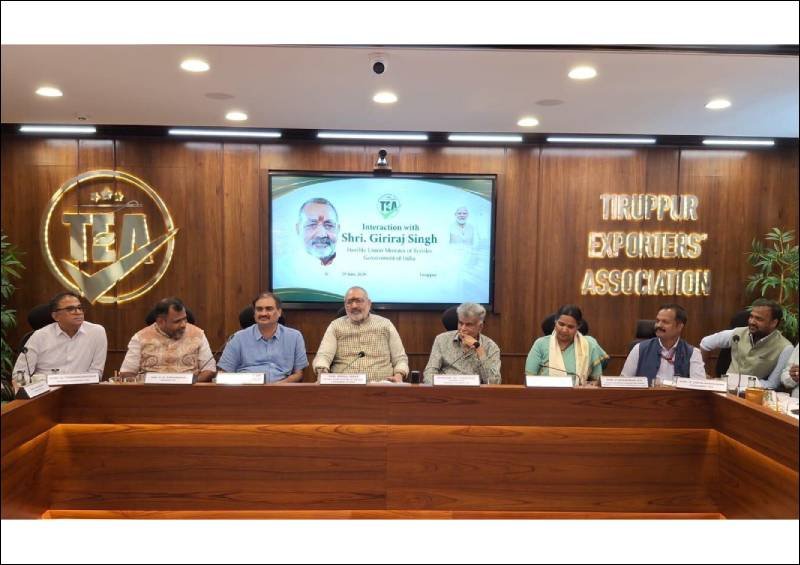
Union Textile Minister Giriraj Singh has called on Tamil Nadu’s textile and apparel industry to accelerate investments in technical textiles and manmade fibre (MMF) manufacturing by leveraging the Centre’s Rs 11,000-crore Production Linked Incentive (PLI) Scheme, while also urging the sector to target a threefold increase in exports.
Addressing industry members at a meeting organised by the Tiruppur Exporters Association in Tiruppur, the minister said the Union government has eased eligibility norms under the PLI scheme to attract greater investments in technical textiles and MMF products, two segments identified as key drivers of India’s next phase of textile growth.
Singh said the Ministry of Textiles is preparing a series of industry-focused initiatives, with some proposals already submitted to the Cabinet and others expected to follow. The upcoming measures, he said, have been designed after considering industry requirements, including investments in machinery, employment generation and manufacturing competitiveness.

He also stressed the importance of closer coordination between the Centre and state governments to strengthen the sector’s growth trajectory.
Highlighting the need to address workforce availability, the minister encouraged textile companies to explore investments in states with a stronger labour pool to support future expansion.
On the silk sector, Singh noted that India’s annual silk production has increased from 26,000 tonnes in 2014 to around 43,000 tonnes, with a target of reaching 60,000 tonnes by 2030. He urged exporters to enhance value addition by producing and exporting silk garments blended with other fibres rather than focusing solely on raw silk.
Speaking at the event, A. Sakthivel, Chairman of the Apparel Export Promotion Council, said the Ministry of Textiles has been introducing new initiatives at regular intervals and noted that all seven PM MITRA parks are now operational, creating new opportunities for investment across the textile value chain.
Meanwhile, K. M. Subramanian, President of the Tiruppur Exporters Association, urged the government to expedite the implementation of the proposed Textile Expansion and Employment Scheme (TEEM) and extend benefits under the Rebate of State and Central Taxes and Levies (RoSCTL) scheme for another three years to sustain export competitiveness.
Later, during interactions with textile machinery manufacturers and officials of the South India Textile Research Association (SITRA) in Coimbatore, the minister reviewed industry requests to include spinning and cotton ginning machinery under the proposed TEEM scheme. Singh asked industry representatives to submit detailed proposals for further examination by the ministry.
The minister also highlighted the need to develop indigenous manufacturing capabilities for knitting, weaving and textile processing machinery, reducing dependence on imported equipment while strengthening India’s textile machinery ecosystem.
During his visit, Singh inaugurated a GM Testing Laboratory at SITRA for cotton and cotton-derived materials. The NABL-accredited facility is expected to enhance traceability, quality assurance and regulatory compliance in the global cotton supply chain by enabling qualitative screening for genetically modified cotton. The laboratory will support exporters in meeting certification requirements under international standards such as GOTS and OCS, reinforcing India’s credibility in premium and sustainable cotton exports.