
Jharkhand Draft Textile Policy Eyes Rs 1,000 Crore Investment
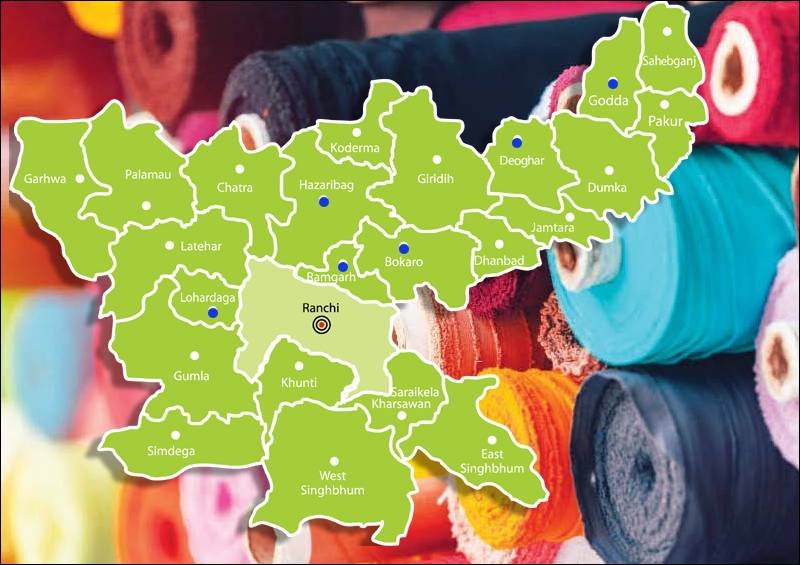
The Government of Jharkhand has released the draft Jharkhand Textile, Apparel & Footwear Policy 2026, outlining an ambitious roadmap to transform the state into a leading textile and apparel manufacturing hub in eastern India. The proposed policy aims to attract investments exceeding Rs 1,000 crore, generate more than 20,000 new jobs, strengthen the state’s textile value chain and promote high-growth segments such as technical textiles, MMF-based products and non-leather footwear.
Building on the achievements of the state’s 2016–2021 policy, which attracted investments of Rs 500–1,000 crore and created 10,000–15,000 direct jobs, the new policy aligns with flagship Central Government initiatives including PM MITRA, the Production Linked Incentive (PLI) Scheme, SAMARTH and the National Technical Textiles Mission (NTTM).
The policy seeks to develop the entire textile value chain from fibre production and spinning to weaving, processing, garmenting and technical textiles. Equal emphasis has been placed on handloom, sericulture, apparel manufacturing, textile machinery, home textiles, accessories and footwear manufacturing, while promoting balanced regional development and technology adoption.

Jharkhand has identified textiles as a core sector under its Industrial and Investment Promotion Policy 2026. The state is India’s largest producer of Tasar silk and currently supports more than 2.5 lakh artisans, rearers, weavers and allied workers through Jharcraft. It also has over 30,000 handloom weavers and more than 120 weavers’ cooperative societies, while textile exports reached Rs 303 crore during FY2024-25.
Recognising the growing global demand for specialised products, the draft policy places strong emphasis on technical textiles, medical textiles and non-leather footwear. The government plans to encourage investments in nonwoven and specialised textile products catering to sectors such as healthcare, infrastructure, agriculture and defence, while also promoting environmentally sustainable manufacturing practices and eco-friendly textiles.
The policy also covers investments across cotton, silk, jute, bamboo, banana fibre, man-made fibres, polyester, viscose, apparel, home textiles, hosiery, technical textiles, textile R&D, testing laboratories and textile accessories.
To attract new investments, the state has proposed a Comprehensive Project Investment Subsidy (CPIS) of 20% of fixed capital investment, subject to a maximum of Rs 50 crore. Additional incentives have been proposed for women, SC/ST and differently-abled entrepreneurs, as well as for investments in technical textiles, footwear and units established in less-developed districts. The total capital subsidy can go up to 35% of fixed capital investment, while mega and anchor projects may receive additional support on a case-by-case basis.
The draft also proposes:
- Interest subsidy of up to 7% for five years.
- 100% reimbursement of State Net SGST for seven years and 40% reimbursement for the following three years.
- 100% reimbursement of stamp duty and registration fees on eligible land purchases.
- Reimbursement of 50% of power tariff for five years.
- 100% electricity duty reimbursement for five years, extendable to seven years for units adopting renewable energy.
- Support for quality certifications, patent registrations, export promotion and cluster development.
Given the labour-intensive nature of the industry, the policy places significant emphasis on employment generation and skill development. It proposes one-time training assistance of Rs 13,000 per trainee, additional support for women and SC/ST candidates, wage subsidies of Rs 5,000 per month for male workers and Rs 6,000 per month for female workers for up to five years, along with reimbursement of employers’ EPF and ESI contributions.
The state also plans to establish incubation centres, promote entrepreneurship, strengthen institutions such as NIFT Ranchi and Jharcraft, and create a Centre of Excellence for Textiles and Technical Textiles to support research, product development, testing and innovation.
To improve industrial competitiveness, the policy proposes the development of integrated textile and apparel parks with plug-and-play infrastructure, common processing facilities, testing laboratories, design centres, warehousing and logistics infrastructure. Cluster-based development, Common Facility Centres (CFCs) and integration with national schemes are expected to improve productivity and attract both domestic and foreign investment.
A dedicated Project Management Agency (PMA) will be established to facilitate project implementation, assist investors, coordinate with government departments and help industries access incentives under both state and central schemes.
With a strong focus on investment, exports, technology adoption, sustainability and employment generation, the draft policy aims to position Jharkhand as a competitive manufacturing destination for textiles, apparel and footwear. By leveraging its strengths in Tasar silk, handloom, technical textiles and labour availability, the state hopes to emerge as a preferred destination for domestic and global investors while expanding its role in India’s textile value chain.