India’s Next Big Fibre Opportunity Could Be In Agriculture Waste!
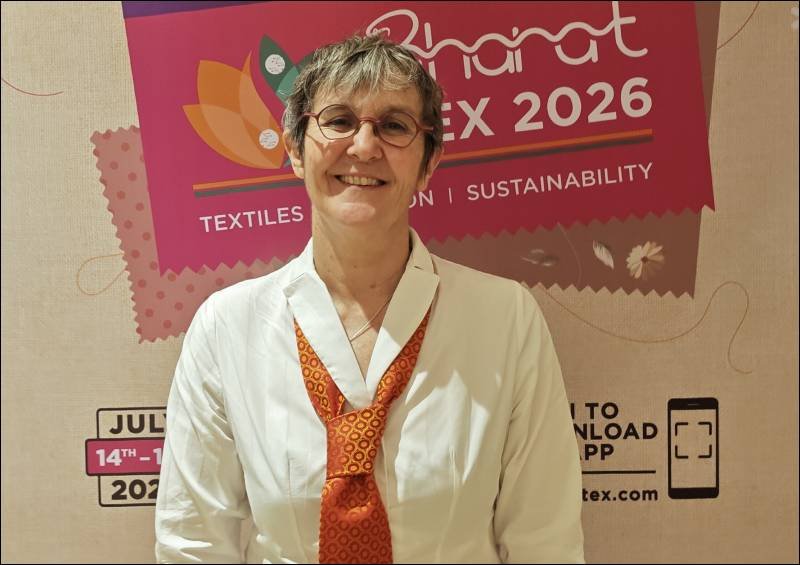
Nicole Rycroft on Bharat Tex 2026, the need to diversify India’s fibre basket and the opportunity to turn agricultural waste into next-generation materials
For Canopy, Bharat Tex 2026 is becoming an important platform for India to demonstrate its ambitions in the global textile industry.
“India has been a long-respected and trusted major manufacturing hub for the fashion industry,” says Nicole Rycroft. “But Bharat Tex is now becoming a convening platform to showcase what is happening in India, how the industry is looking forward and how the government is thinking about strategically positioning the industry for the future.”

The event, she believes, is bringing together manufacturers, brands, investors and policymakers at a time when the global textile industry is undergoing significant change.
A key theme emerging from discussions at Bharat Tex is the need for India to diversify its fibre basket. The country’s textile industry has traditionally relied heavily on a limited number of legacy fibres. Rycroft believes this dependence creates risks in an increasingly uncertain geopolitical and economic environment.
“Diversifying the fibre basket is increasingly important,” she says. “There is a real interest, even from a fibre sovereignty perspective, in how to scale the next-generation alternative fibres available here in India.”
These alternatives could include fibres made from waste textiles, agricultural residues and other materials that are currently discarded or underutilised.
Turning agricultural waste into textile fibre
One of the most promising opportunities is the conversion of agricultural residues into textile fibres. Canopy has been involved in a pilot project using Indian wheat straw to produce a Lyocell fibre. According to Rycroft, the quality of the resulting fibre has been particularly encouraging.
“The hand feel, the drape and the technical performance of that fibre being as close to a conventional fibre as it was is really quite remarkable,” she says.
The challenge now is to move from pilot projects to commercial-scale production. Rycroft points to plans by AM Green to develop significant capacity for straw-based dissolving pulp, with the intention of building its first mill in the coming years.
For such an ecosystem to scale, strong market signals will be essential. Developing new fibres requires investment in research, infrastructure and production capacity. Clear and aggregated demand from brands and manufacturers can help reduce the risks associated with those investments.
Rycroft believes brands, manufacturers, fibre producers and innovators need to work together to support the introduction of new materials.
“The question is how to create the right pre-competitive vehicles that help defray some of the risk associated with changing the fibre basket,” she says.
India’s opportunity
Rycroft believes India is particularly well-positioned to become a leader in next-generation material production. The country produces an estimated 90 million tonnes of agricultural residues annually, much of which is burnt. Converting this waste into valuable raw material for textiles and other industries could create both environmental and economic benefits.
“India is in an incredibly exciting position to be an early leader in next-generation material production,” she says.
The opportunity is particularly significant as India seeks to expand its fashion and textile exports to high-value markets such as Europe, where sustainability requirements are becoming increasingly important.
For Rycroft, next-generation materials are no longer simply an environmental preference. They are increasingly becoming a competitive requirement. India may not always be able to compete with countries such as China purely on price. Its competitive advantage could instead lie in becoming a trusted, innovative and sustainable manufacturing partner.
“Next-generation materials will not just be a nice-to-have. They are increasingly a must-have for market entry, especially in value-added markets like the EU,” she says.
The wheat-straw-to-Lyocell project demonstrates the potential of this approach. The fibre has already been incorporated into garments by global brands, showing that Indian agricultural waste can become part of international fashion supply chains.
For Rycroft, this is only the beginning. As India looks to strengthen its position as a global textile and apparel sourcing hub, the next phase of growth may depend not only on how much the country can manufacture, but also on what it chooses to manufacture with.
The future of Indian textiles could, quite literally, begin in the fields.