Bharat Tex Reflects Growing Industry Appetite For Green Investment
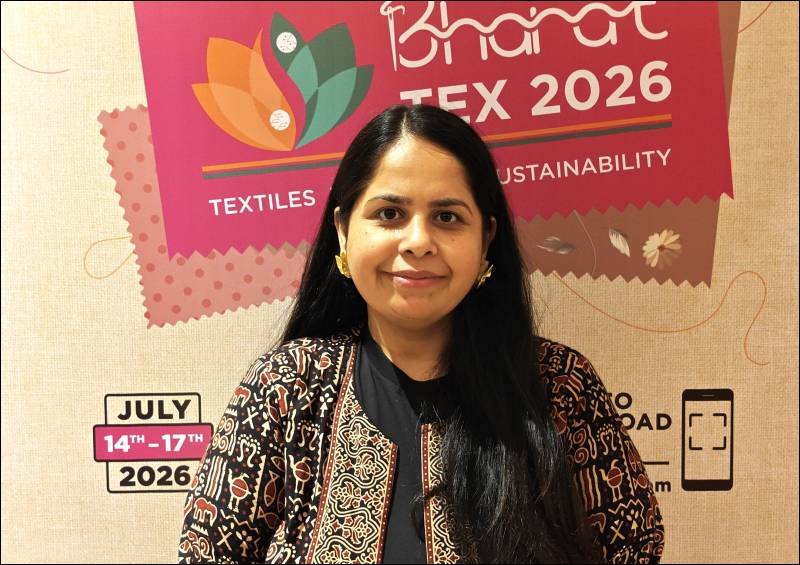
Shruti Singh, Director – India, Canopy, on Bharat Tex 2026, the growing focus on sustainability and the need for greater coordination to scale next-generation materials
The growing return of international buyers, stronger investor interest and deeper conversations around sustainability are among the key trends Shruti Singh, Director – India, Canopy, observed at Bharat Tex 2026.
According to Singh, the exhibition is growing not only in scale but also in the quality of discussions around sustainability and the circular economy.

“This is the largest platform for the textile industry in India and every year it is getting better in terms of scale and the quality and depth of conversations, especially around sustainability and the circular economy,” she says.
One of the most encouraging trends, she says, is the return of international visitors and global buyers to the exhibition.
“The fact that people are coming again is proof that Bharat Tex is a platform that is here to stay and is able to cater to global needs while showcasing what India has to offer,” she says.
For Canopy, the event also provided an opportunity to highlight the potential of agricultural residues as a source of next-generation textile fibres. The wheat straw used in the Project Latvus came from Punjab, creating a direct link between India’s agricultural economy and the global textile value chain.
Singh believes agricultural residues from across the world can potentially be used to develop alternative fibres. The wheat-straw-to-Lyocell initiative therefore represents an opportunity to connect local agricultural resources with global textile supply chains.
Another positive development she observed at Bharat Tex was the growing interest in the green economy and green investment. “I am seeing a lot of investors joining and I think that is a positive signal,” she says.
Singh was also encouraged by the response from brands and supply-chain stakeholders towards new material solutions, as well as the scale of production being planned for next-generation fibres. However, for Singh, scaling these opportunities will require more than individual collaborations.
“One thing is collaboration and doing projects together. The other thing is coordination-sharing information, sharing risks, sharing costs and sharing knowledge,” she says.
She believes Bharat Tex is increasingly creating a platform for this kind of industry coordination, bringing together investors, brands, manufacturers and other stakeholders.
As India explores the potential of agricultural residues such as wheat straw and seeks to build a stronger green economy, greater coordination across the value chain will be critical to accelerating the development of next-generation textile materials.
“Every year millions of tonnes of agricultural residue are burnt as waste. Latvus showed it can become fibre that global brands can incorporate into their future fibre mix. The proof exists. Now the work is building the coordination that turns one pilot into an industry.”