Bharat Tex 2026: India’s Textile Ambition Takes Centrestage
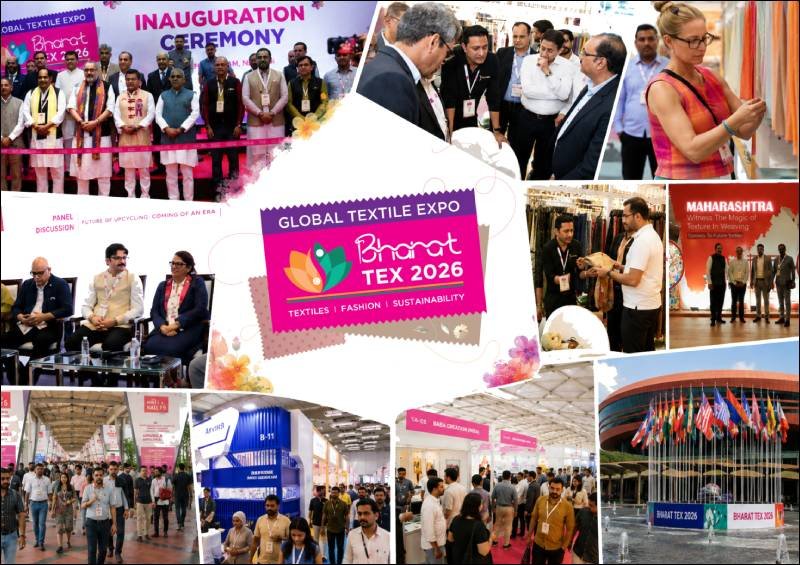
With record participation, major investment commitments, global partnerships and discussions spanning trade, technology and sustainability, Bharat Tex 2026 has emerged as more than an exhibition, it is becoming a platform for India’s textile ambitions.
When Bharat Tex 2026 opened at Bharat Mandapam, New Delhi, it presented a powerful picture of India’s textile industry in transition. Spread across more than 16 lakh sq. ft., the four-day event brought together 1,647 exhibitors, nearly 95,000 business visitors, 11,315 buyers including 6,090 international buyers and participants from 138 countries.
More than 28,500 B2B meetings, over 100 B2G and G2G interactions and serious business enquiries worth approximately US$ 2.8 billion were generated during the event. Around Rs 14,300 crore in textile investment commitments were also catalysed, with major announcements from Karnataka, Bihar, Maharashtra and Andhra Pradesh, alongside a Rs 4,800 crore investment commitment from RE&UP.

The numbers reflected the scale of the event. But the larger story was about India’s changing position in the global textile industry.
From Supplier To Strategic Partner
Inaugurating the event, Union Minister of Textiles Giriraj Singh highlighted Prime Minister Narendra Modi’s 5F Vision Farm to Fibre to Factory to Fashion to Foreign and positioned Bharat Tex as a platform connecting Indian enterprises with global markets.
“The world doesn’t just need a supplier, it needs a reliable partner with innovation at scale. From sustainable and circular fibres to smart manufacturing and technical textiles, India is leading the future of textiles,” the Minister said.
The Government’s target of increasing textile exports from around US$ 37.7 billion to US$ 100 billion by 2030 formed an important backdrop to the event. Initiatives such as the PM MITRA Mega Textile Parks, PLI Scheme, National Technical Textiles Mission and SAMARTH skilling programme are expected to support this ambition.
Trade was another central theme. India’s recent agreements with Australia, the UAE, Oman and the UK, along with ongoing negotiations with the European Union and other markets, are creating new opportunities for textile and apparel exporters.
A major milestone was the Letter of Intent signed between the Bharat Tex Trade Federation and Première Vision Paris. The partnership aims to strengthen India–Europe collaboration in design, innovation, sustainability, buyer-seller engagement and global market access.
States Drive The Next Phase Of Growth
State-led growth emerged as one of the strongest themes of Bharat Tex 2026. Eight state sponsors, including Madhya Pradesh, Bihar, Uttar Pradesh, Punjab, Maharashtra, Gujarat, Karnataka and Tamil Nadu, showcased their textile capabilities, investment opportunities and policy initiatives.
State sessions highlighted opportunities across traditional textiles, apparel, technical textiles and advanced manufacturing. The participation of Chief Ministers and senior ministers underlined the growing importance of textiles in regional industrial and employment strategies.
The investment announcements reinforced this momentum. Karnataka committed Rs 2,821 crore, Bihar Rs 1,476 crore, Maharashtra Rs 1,095 crore and Andhra Pradesh Rs 4,100 crore, while RE&UP announced plans to invest Rs 4,800 crore in India.
Together, these commitments demonstrate the increasing competition among states to attract textile manufacturing, technology and investment.
Sustainability Moves To The Centre
Across the knowledge programme, sustainability emerged not as a separate subject but as a central part of the industry’s future.
More than 100 knowledge sessions brought together policymakers, global experts, brands, manufacturers, investors and academicians to discuss circularity, responsible sourcing, sustainable materials, traceability, chemical management and sustainable finance.
Discussions examined everything from agricultural waste-based fibres and circular textile solutions to fair commodity pricing and investment in clean technologies. The Better Cotton Initiative roundtable focused on responsible sourcing and traceability, while the Sustainability Conclave underlined the need for coordinated action across finance, sourcing, technology and skills.
The CITI Textile Sustainability Awards recognised initiatives across resource efficiency, energy and emissions, circular economy, sustainable materials, social responsibility and industry collaboration.
The Eco-Stitch Sustainability & Circularity Hub further brought together recyclers, manufacturers, brands, innovators and technology providers to showcase practical solutions for a more sustainable and circular textile industry.
The message was clear: sustainability is increasingly moving from corporate commitment to business necessity.
Technology, Skills and Innovation
Technology and innovation were equally prominent at the event. The Sanrachna Hackathon showcased technical textile solutions developed by young innovators, including protective garments for farmers, diabetic wound-care products and lightweight insulated mattresses for extreme climates.
The event also highlighted the importance of skills and inclusion. More than five lakh people have been trained under the SAMARTH programme, nearly 88% of them women. Special exposure visits for more than 250 entrepreneurs and weavers from Aspirational Districts connected MSMEs with buyers, exhibitors and industry experts.
From AI-enabled business matchmaking to technical textiles and digital commerce, Bharat Tex demonstrated how technology is increasingly influencing every stage of the textile value chain.
Heritage Meets Global Ambition
India’s traditional textile strengths were also central to the event’s narrative.
Discussions involving designers Rahul Mishra and Vaishali Shadangule explored how Indian fashion brands can build global businesses. Other sessions examined the potential of handlooms, handicrafts and traditional weaving traditions to become premium global differentiators through design, craftsmanship and cultural storytelling.
The CMAI Brands of India Pavilion brought together more than 70 Indian apparel brands, including a dedicated showcase for the intimate and innerwear segment.
The message emerging from these discussions was that India’s heritage can be a powerful global asset but only when supported by design, consistency, branding and market access.
From Exhibition to Industry Platform
The real impact of Bharat Tex 2026 extended beyond the exhibition floor.
The event facilitated thousands of buyer-seller meetings, investment discussions and government-to-business interactions. International participation included delegations from countries such as New Zealand, Sri Lanka, Russia, Cambodia and Portugal, along with business delegations from the US, Japan, the UK, Spain, Italy, South Korea, the UAE, Australia, France and Germany.
The presence of the International Apparel Federation Board Meeting further strengthened India’s engagement with the global apparel ecosystem.
By bringing together governments, manufacturers, exporters, buyers, investors, designers, technology providers and sustainability experts, Bharat Tex 2026 created a platform where the different parts of India’s textile ambition could meet.
The Road Ahead
Bharat Tex 2026 has shown that India’s textile opportunity is no longer simply about producing more. It is about producing at scale, with greater speed, innovation, sustainability and global integration.
The next challenge is to convert the investment commitments, business enquiries and partnerships generated during the event into long-term projects and export growth.
If that momentum is sustained, Bharat Tex can become more than one of the world’s largest integrated textile events. It can become a catalyst for India’s next textile transformation from farm to fibre, factory to fashion and, ultimately, from India to the world.