
ITMF Survey: Textile Industry Stays Cautiously Optimistic
The global textile industry witnessed a slight weakening in business conditions during July 2026, although companies remain cautiously optimistic about the months ahead, according to the latest 39th Global Textile Industry Survey (GTIS) released by the International Textile Manufacturers Federation (ITMF).
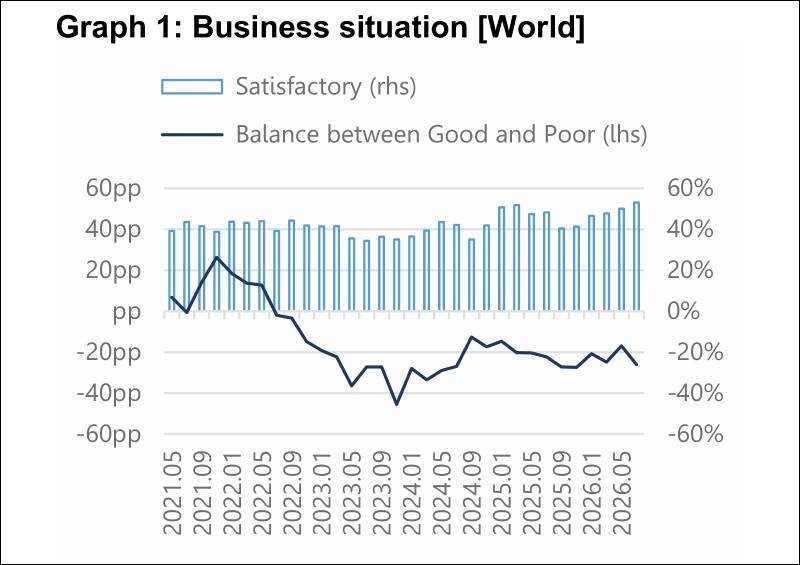
The survey, conducted between July 14 and 22, 2026, found that 10% of respondents rated their business situation as good, 53% as satisfactory and 37% as bad, resulting in a business balance of -26 percentage points (pp). While lower than the -17pp recorded in May, the result remains significantly above the lows seen in 2023.
All regions reported negative business conditions, with South Asia posting the strongest performance at -3pp, while North and Central America recorded the weakest reading at -58pp. Across the textile value chain, brands and retailers were the only segment to remain in positive territory at +11pp, whereas machinery manufacturers reported the weakest sentiment at -40pp. Garment manufacturers experienced a notable decline, with their business balance falling from +5pp in May to -25pp in July.

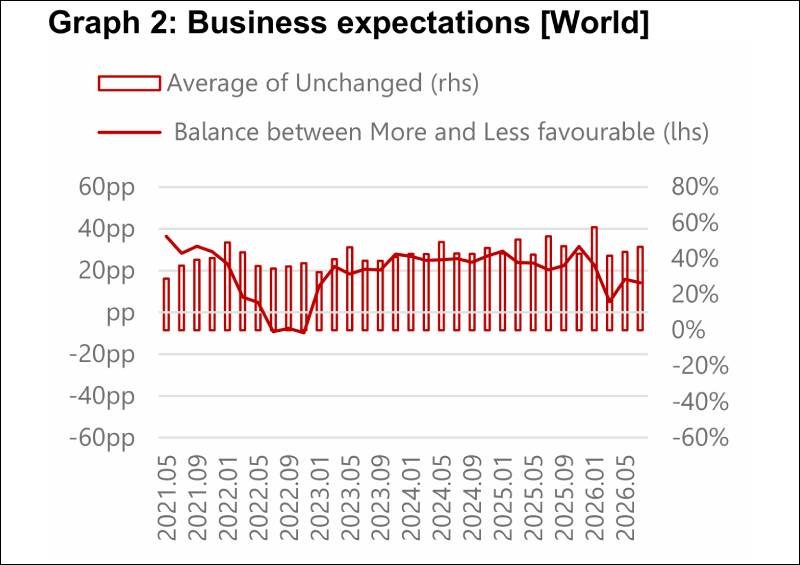
Despite the softer business environment, industry expectations for the next six months remained positive. The global expectations balance eased marginally from +16pp to +14pp, with nearly half of respondents expecting business conditions to remain unchanged. Africa (+50pp) and South Asia (+32pp) emerged as the most optimistic regions, while machinery manufacturers were the most confident segment at +36pp.
The survey also highlighted a decline in order intake, which dropped to -27pp from -9pp in May, suggesting that the previous reading may have been an outlier. Average order backlog slipped to 2.3 months, while global capacity utilisation fell to 71%, ranging from 75% in South-East Asia to 64% in North and Central America.
Weak demand continues to be the industry’s primary concern, cited by 56% of respondents, followed by geopolitical uncertainty at 46%. Concerns related to raw material prices, energy costs and tariffs have eased considerably, with tariff-related concerns dropping to 10%, down sharply from a peak of 40% in September 2025.
On a positive note, global order cancellations declined to 2%, while inventory conditions improved. Stock levels continued to build among brands and retailers, whereas upstream segments of the textile value chain maintained relatively lean inventories.
The survey indicates that while the textile industry continues to face demand-side challenges and geopolitical risks, confidence in a gradual recovery remains intact, particularly in emerging textile-producing regions.