
The Next Life Of Textiles
From Textile Waste to Engineered Materials: A Circular Opportunity for India
Waste → Fibre → Material → Value
India’s textile industry is entering a new phase in its sustainability journey. The challenge is no longer limited to managing production waste; it is how to deal with the growing volume of heterogeneous textile waste generated across manufacturing, consumption and end-of-life streams.

The scale is significant. The Ministry of Textiles’ report ‘Mapping of Textile Waste Value Chain in India’ estimates textile waste generation in India at approximately 7.07 million tonnes annually, with both pre-consumer and post-consumer waste contributing substantially. The supplied project material identifies approximately 42% as pre-consumer and 58% as post-consumer waste.
Unlike conventional industrial raw materials, textile waste is highly variable. It may contain cotton, polyester, denim, wool, nylon, blended fibres and discarded garments, each with different physical and processing characteristics.
This variability makes recycling a technical as well as a logistical challenge. The industry needs collection and sorting systems capable of separating and preparing these materials, together with technologies that can process difficult fractions at commercial scale.
The objective should not simply be to keep textile waste out of landfill. It should be to identify the highest-value technically feasible next application for each waste stream.
 From Waste to Engineered Material
Circularity is often associated with garment-to-garment recycling or the recovery of fibres for yarn production. These pathways remain important, but they cannot accommodate every textile waste fraction.
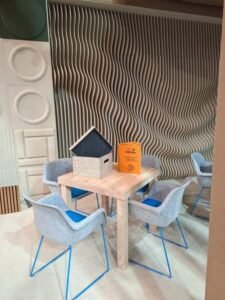
Short fibres, mixed materials and certain post-consumer textiles may not be suitable for conventional textile-to-textile recycling. For such fractions, textile-to-industrial material conversion offers another potential route.
The question therefore changes from ‘Can this textile become another garment?’ to: ‘What useful engineered material can be manufactured from these recovered fibres?’
The proposed platform addresses this opportunity through a dry mechanical process for converting difficult textile fractions into engineered nonwoven materials.
The basic sequence is: Collection → Sorting → Shredding → Fibre Opening → Blending → Dosing → Airlay Formation → Consolidation → Product Development
The incoming textiles are first collected, sorted and prepared. They are then shredded and opened to release the fibres. Different fibre streams can be blended according to the requirements of the target product.
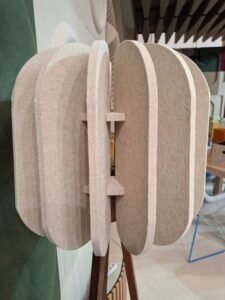 Where required, low-melt thermofibres or powder resins can be incorporated to provide the necessary bonding. The prepared fibres are then formed into a uniform web using airlay technology and consolidated into a stable nonwoven structure.
The significance of this process is that the output is no longer simply recycled waste. It becomes an engineered material whose composition, weight, density, thickness and bonding characteristics can be developed around a specific industrial application.
The supplied project material identifies potential inputs including cotton, polyester, denim, wool, nylon, shredded garments and selected bio-fibres. It indicates an indicative fibre-length range of approximately 1-80 mm and product weights of approximately 100–6,000 gsm, depending on the material and application.
The proposed process is dry, with near-zero water requirement and limited chemical dependency. Its modular architecture is designed to expand from approximately 30 tonnes per day to 60 tonnes per day or more.
These characteristics are particularly relevant to textile recycling because they provide flexibility in handling different fibre streams while avoiding the water-intensive nature of some alternative recycling processes.
However, the sustainability performance of any recycling system must ultimately be assessed across the complete lifecycle, including energy use, transportation, feedstock preparation, binders and the useful life of the finished product.
 Engineering the Fibre for the Market
The technical opportunity begins after fibre recovery. Recovered fibre is a raw material; its value depends on what can be made from it.
This requires a shift from waste processing to material formulation and product engineering.
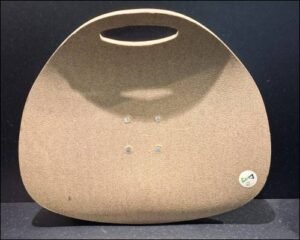
Fibre type and length, blend ratios, web weight, density, binder content and consolidation conditions can all influence the properties of the finished nonwoven. The objective is therefore not to create one universal recycled product, but to develop materials according to the requirements of individual applications.
A typical development pathway can be expressed as: Feedstock Characterisation → Fibre Preparation → Formulation → Prototype → Testing → Customer Qualification → Commercial Production
This application-led approach is essential. An automotive material, for example, will have different requirements from a construction insulation product or a geotextile.
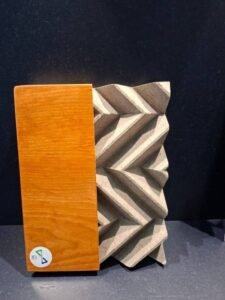 Potential markets for engineered recycled nonwovens extend across several technical-textile sectors. In Buildtech, applications may include acoustic panels, thermal insulation, ceiling systems and partitions. Mobiltech offers opportunities in automotive felts, under-carpet materials, door liners, headliners and insulation. Geotech may include geotextiles, drainage blankets and erosion-control products, while Hometech can encompass upholstery, cushioning and carpet backing.
The opportunity also extends into Agrotech, Clothtech, Packtech and Sportech, with potential applications in agricultural mats, functional textile components, fibre-based packaging, sports flooring and related products.
These are potential applications, not automatic commercial outcomes. Each requires product development, performance testing and customer qualification.
This is ultimately what separates recycling from circular manufacturing.
The recycling process provides the raw material; engineering creates the product; the market creates the value.
 Building a Commercial Circular Loop
A commercially viable circular-materials platform requires four elements to operate together: Reliable Feedstock + Appropriate Technology + Qualified Product + Market Demand
The proposed model is based initially on a 30-tonnes-per-day platform. At full capacity, the supplied project proposal estimates approximately 10,500 tonnes of annual input, around 8,500 tonnes of estimated CO₂e savings and more than 100 direct jobs.
These are proposal-level estimates and would require validation under actual operating conditions, including feedstock quality, plant utilisation, energy consumption and logistics.
The operating model is straightforward: Collect → Sort → Process → Engineer → Test → Qualify → Supply. The complexity lies in making every stage reliable.
 Collection must provide sufficient and consistent feedstock. Sorting must control variability. Processing must produce repeatable fibre quality. Product development must deliver defined technical properties. Finally, customers must qualify the material and incorporate it into their products or processes.
This is why circularity cannot be viewed as a recycling-plant issue alone.
Government and local authorities can support land, clearances, collection infrastructure and access to waste streams. Industrial enterprises can provide investment, plant operations, product development and B2B market execution. Technology partners can provide equipment, commissioning, training and process support.
Extended Producer Responsibility can further strengthen the ecosystem by encouraging producers, brands and retailers to participate in collection, recycling and end-of-life management.
The entire value chain therefore has a role to play, from manufacturers and brands to consumers, recyclers and industrial users.
 From Recycling to Materials Manufacturing
The greatest test of a recycling technology is ultimately not how much waste it can process, but whether the resulting material can compete in the market.
Industrial customers will evaluate recycled materials on cost, consistency, availability, performance and technical specifications. Sustainability adds value, but it cannot replace reliable product performance. This makes market development as important as recycling technology.
The industry should therefore move away from asking: How much textile waste can we recycle? and focus instead on: How much qualified industrial material can we manufacture from recovered textiles, and how consistently can we supply it?
 That is the point at which recycling becomes manufacturing.
India does not need one solution for every textile waste stream. It needs a hierarchy of recovery pathways, reuse where possible, textile-to-textile recycling where technically and economically viable, and industrial-material conversion for difficult fractions that cannot return efficiently to conventional textile applications.
Engineered nonwovens can potentially occupy an important position within this hierarchy.
The opportunity is not simply environmental. A successful circular-materials industry can create new manufacturing capacity, skilled employment, domestic material supply chains and new markets for technical textiles.
The next life of a discarded textile may not always be another garment, fabric or yarn. For many difficult fractions, its next life could be as an engineered industrial material.
The equation is simple: Waste → Fibre → Material → Performance → Market → Value.