Santoni: Building The Intelligent Knitting Factory
How an Italian knitting machine pioneer is building a multi-brand, multi-location platform for automated, AI-enabled textile production
More than a century after Santoni began in Italy, the company’s story is no longer only about individual knitting machines. It is increasingly about an interconnected manufacturing ecosystem, one that combines specialist brands, distributed engineering capability, digital platforms and a clear ambition to make textile production more intelligent.
From Italian Pioneer to Global Knitting Ecosystem
Founded in Brescia in 1919, Santoni built its reputation as an Italian pioneer in sock and circular knitting machinery. Its later breakthroughs in electronic seamless technology helped move knitted production beyond hosiery and underwear into sportswear, beachwear, medical apparel, knitwear and technical applications. Today, the wider Santoni organization combines that Italian engineering heritage with an expanding industrial base in China and Germany. The result is a business designed to serve customers across machine categories, production scales and regional markets rather than through a single product line.

Five Brands, One Market Logic
The group’s core five-brand architecture illustrates how Santoni has widened its reach across circular knitting. Each name addresses a distinct market position, while shared engineering, sourcing, service and digital capabilities create the potential for scale.
| Core machine-brand portfolio | ||
| Brand | Primary role | Strategic contribution |
| Santoni | Seamless and advanced circular knitting | Flagship technology, premium engineering and application breadth |
| Jingmei | Large-diameter circular knitting | Competitive production platforms and strong regional manufacturing reach |
| Hengsheng | Mid-diameter solutions | Coverage between seamless, hosiery and large-diameter segments |
| Terrot | Large-diameter circular knitting | Specialized capability for Jacquard |
| Pilotelli | Large-diameter circular knitting | Specialized capability for high speed |
The 2023 acquisition of Germany’s Terrot, including the Pilotelli line, added further large-diameter expertise and broadened the group’s technical spectrum. In practical terms, Santoni can now position its brands less as isolated labels and more as complementary gateways into one knitting ecosystem, matching customers to the right architecture, price point and application.
Four Locations, Shared Engineering Momentum
Santoni’s operating model is supported by four principal R&D and production anchors: Bresia, the headquarters of the group and seamless technology centre; Shanghai, the group’s China headquarters and seamless and large diameter-technology centre; Quanzhou, home to Jingmei’s large-diameter manufacturing capability and Chemnitz, the German home of Terrot and Pilotelli. Together, these sites connect Italian industrial heritage with Chinese manufacturing scale and German circular-knitting engineering.
“The competitive advantage is not simply having more factories. It is turning distributed expertise into one learning system.”
This network gives the group several advantages: engineering teams can specialize by machine type; manufacturing can be located close to important customer clusters; and product knowledge can circulate across brands. The challenge is integration. Common standards for data, components, software, service and quality are what transform four sites into a genuine platform rather than a collection of factories.
The North Star: Autonomous, Data-Driven Knitting
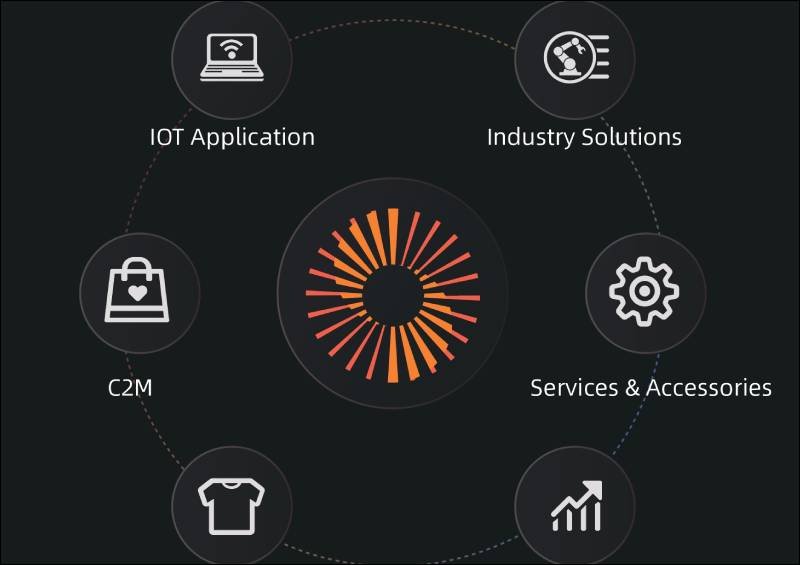
Santoni’s future-oriented goal can be stated simply: Move from supplying intelligent machines to enabling an intelligent factory. Its developing ecosystem already points in this direction through knitting industrial-internet infrastructure, real-time production monitoring, process optimization, material knowledge, C2M workflows and textile automation. AI can become the coordination layer that turns these capabilities into faster decisions and more autonomous production.
What that future could look like
- Self-optimizing production: Machine settings continuously adjusted using live quality, speed and energy data.
- Predictive maintenance: Algorithms identifying wear or abnormal behaviour before downtime occurs.
- AI-assisted fabric development: Faster translation of design intent into machine-ready parameters and viable material combinations.
- Automated material flow: Tighter coordination among yarn handling, knitting, inspection and downstream operations.
- Connected service: Remote diagnostics and knowledge tools that shorten troubleshooting and standardize support across regions.
Why the Strategy Matters
Textile manufacturers are under simultaneous pressure to shorten runs, diversify products, reduce waste, lower energy use and respond faster to demand. A connected multi-brand portfolio allows Santoni to address those pressures at several levels: machine performance, factory orchestration and product creation. The most important shift is commercial as much as technical. Value moves from the sale of a machine toward the continuous improvement of a customer’s production system.
Outlook
Santoni’s next chapter will depend on how convincingly it connects heritage with software, and specialization with scale. The building blocks are visible: differentiated machine brands, four engineering and production anchors, and a digital ecosystem aimed at intelligent manufacturing. If the group can unify those assets around trustworthy data and practical AI, it will not merely manufacture the machines that knit tomorrow’s fabrics, it will help define how tomorrow’s factories think.