Global Cotton Output Likely To Edge Past Consumption, But Supply Risks Persist
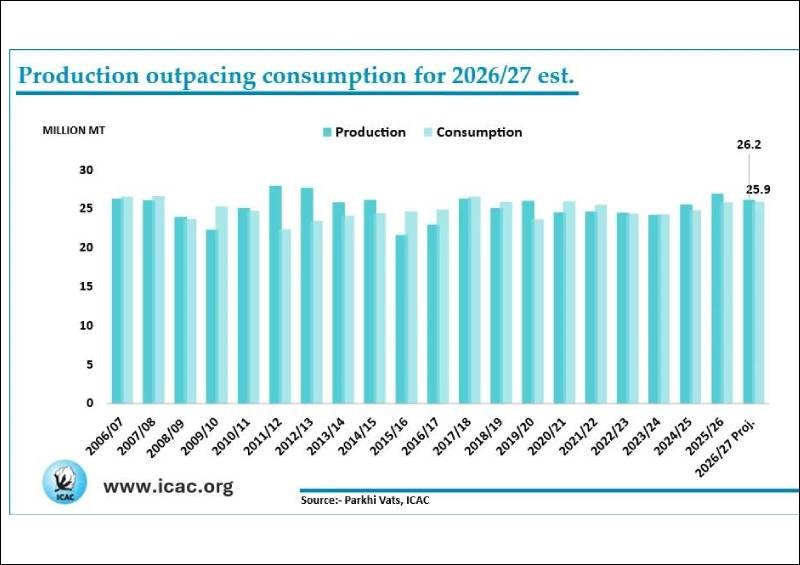
Global cotton production is expected to marginally exceed consumption in the 2026-27 season, but the projected surplus could narrow as weather, pest and crop-related risks emerge, according to the International Cotton Advisory Committee (ICAC).
Global cotton output is projected at 26.2 million tonnes against consumption of 25.9 million tonnes, leaving a surplus of around 300,000 tonnes. However, ICAC said production estimates typically decline by about 100,000 tonnes from initial projections as crop conditions become clearer.
With normal seasonal developments, global production could ease to around 26-26.1 million tonnes, leaving little cushion in the market. Any major weather disruption or pest outbreak could result in a sharper downward revision.

China’s domestic cotton availability has improved following sales from state reserves that began on July 20. The auctions have averaged around 8,000 tonnes each. However, the eventual replenishment of reserves and potential weather risks in Xinjiang could push China’s import demand higher later in the season.
India’s cotton outlook has also strengthened, with 2025-26 production revised upwards to 5.5 million tonnes, up 9% from earlier estimates. Cotton consumption is estimated at nearly 5.9 million tonnes, an increase of 7%, supported by firm domestic mill demand and growth in textile exports.
The country’s longer-term cotton prospects are also being supported by government initiatives, including the five-year Cotton Mission. Digital programmes such as the Kapas Kisan app, which has enrolled more than 4.1 million farmers, and the blockchain-based traceability system under Kasturi Cotton Bharat are aimed at strengthening the cotton value chain.
Pakistan, meanwhile, continues to face production challenges. Climate variability, pest attacks, poor seed quality and high input costs have weighed on output. Cotton production is estimated at 1.15 million tonnes in 2025-26, down 4%, and is projected to fall further to 1.10 million tonnes in 2026-27. The decline is likely to increase the country’s dependence on imported raw cotton to meet textile industry requirements.
In the US, higher planted acreage has improved the production outlook. Cotton area has been revised upwards by 5% to 3.3 million hectares, with 2026-27 production projected at 2.9 million tonnes.
Meanwhile, changes in US trade policy are adding another layer of uncertainty to global cotton and textile flows. Newly implemented Section 301 tariffs of 10%-12.5% are affecting sourcing economics, with manufacturing hubs such as Vietnam potentially facing higher costs. Global buyers are consequently reassessing sourcing strategies.
With the projected global surplus remaining relatively small, the cotton market is likely to remain sensitive to crop developments and trade-policy changes. Weather conditions, pest pressures, China’s reserve policy and shifting global sourcing patterns will be key factors influencing cotton prices and availability through the 2026-27 season.