
Global Cotton Stocks Seen Falling To 15-Year Low In 2026/27
Global cotton markets are heading towards a tighter supply situation in 2026/27, with world cotton ending stocks projected to decline by nearly 5.5 million bales, or 7%, to 69.9 million bales, according to the latest Cotton and Wool Outlook report from the US Department of Agriculture (USDA).
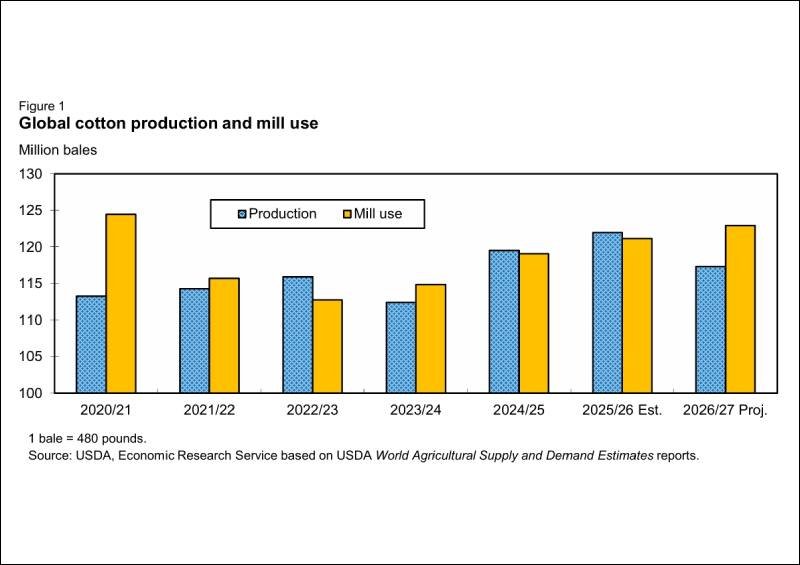
The projected stock level would be the lowest in 15 years, while the global stocks-to-use ratio is also expected to fall to its lowest level since 2010/11. The tightening supply outlook comes as global cotton mill use is forecast to increase while production declines, creating the widest gap between consumption and output since 2020/21.
Global cotton production for 2026/27 is projected at 117.3 million bales, down 4%, or 4.6 million bales, from the previous year. In contrast, global cotton mill use is forecast to rise 1.5% to 122.9 million bales, the highest level since 2020/21.

The increase in mill use is being supported by expectations of steady global economic growth and higher polyester prices, which could improve the relative competitiveness of cotton for textile manufacturing.
China, India, Brazil and the United States are expected to remain the dominant cotton producers, collectively accounting for around 76% of global production in 2026/27. China is projected to produce 33.5 million bales, down 6% from the previous year, while India is the only major producer expected to record an increase, with output projected at 24 million bales, up 1%.
Brazil’s production is forecast to decline marginally to 18.5 million bales, while US production is also expected to fall. Pakistan’s output is projected at 5 million bales, down nearly 6%, while Australia’s production is forecast to decline by one-third to 3 million bales due to lower reservoir levels and reduced harvested area.
India is also expected to remain the world’s second-largest cotton spinner. Its cotton mill use is projected at 26.5 million bales in 2026/27, an increase of 500,000 bales, or 2%, from the previous year. India is expected to account for around 22% of global cotton mill use.
China will continue to lead global cotton consumption, with mill use projected at 42 million bales. Pakistan’s mill use is forecast to rise 3% to 10.2 million bales, while Bangladesh’s is expected to increase nearly 3% to 7.6 million bales. Vietnam’s mill use is projected at 8.2 million bales, while Turkey is expected to remain unchanged at 6.8 million bales.
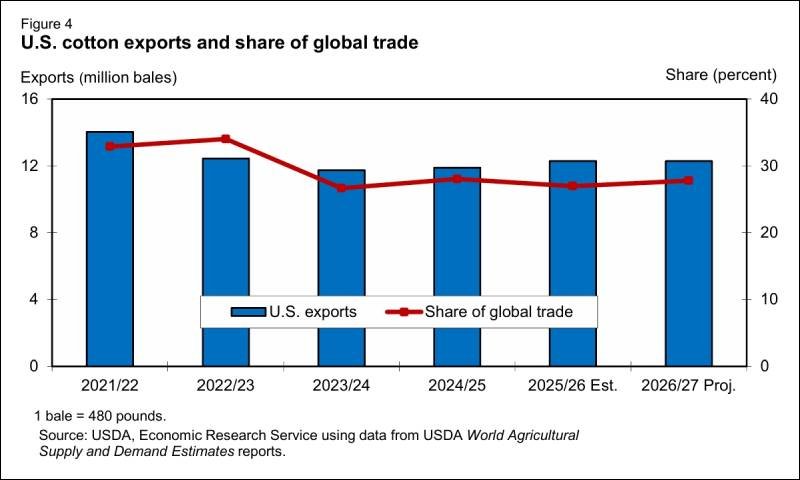
Global cotton trade is forecast at 44.2 million bales in 2026/27, slightly below the previous year. Brazil is expected to remain the largest exporter, with shipments projected at 15.5 million bales, matching its record 2025/26 level and accounting for around 35% of global trade. US exports are forecast at 12.3 million bales, representing about 28% of the global total.
Australia’s exports, however, are projected to decline by 1.1 million bales, or 19.5%, to 4.5 million bales because of its lower production outlook.
On the import side, Vietnam is projected to become the largest cotton importer in 2026/27, with imports estimated at 8.2 million bales to support its expanding textile industry. China’s imports are forecast at 7 million bales, while Bangladesh is expected to import 7.4 million bales. Pakistan’s imports are projected to rise to 5.1 million bales.
India’s cotton imports are forecast to fall to 3 million bales from 5.1 million bales in 2025/26. The decline is attributed to a slightly larger domestic crop and India’s highest beginning stock level in five years.
The tighter global balance is also reflected in the US cotton outlook. USDA has lowered its 2026/27 US production forecast to 13.2 million bales, 3% below its August estimate and 5% below the previous season. The crop is projected to be the second-lowest since 2015/16.
Lower yields in the Southwest are a major factor behind the reduction. US harvested area is projected at nearly 8.2 million acres, while abandonment is expected to approach 22%, compared with 15.6% last season. National yield is forecast at 776 pounds per harvested acre, below both last season’s 852 pounds and the three-year average of 881 pounds.
US cotton ending stocks are projected at 3.6 million bales, down 13% from 2025/26. With lower supplies and a reduced stocks-to-use ratio, USDA has projected the 2026/27 average upland cotton farm price at 78 cents per pound, compared with 62 cents estimated for 2025/26.
Overall, the combination of declining production, rising mill consumption and falling inventories points to a tighter cotton market in 2026/27. USDA’s projections indicate that global cotton prices could face upward pressure as inventories move to their lowest level in 15 years and the stocks-to-use ratio reaches its lowest point in more than a decade.
US Cotton Crop Shows Mixed Regional Performance
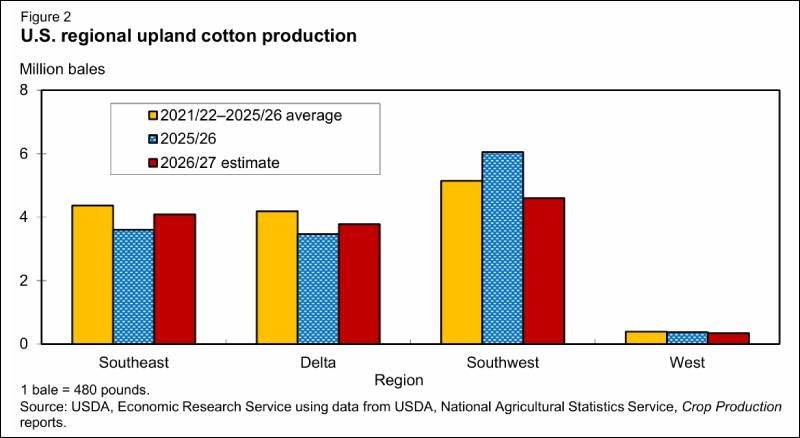
Within the US, production trends vary significantly by region. Southwest upland cotton production is forecast at 4.6 million bales, down 24% from the previous year, with the region’s yield projected at 514 pounds per harvested acre, the lowest since 2003/04.
The Southeast is expected to produce 4.1 million bales, up nearly 14%, while Delta production is projected to increase 9% to 3.8 million bales. Production in the West is forecast at just 339,000 bales, making it the region’s second-lowest output in nine decades.
As of September 13, 57% of US cotton acreage had bolls opening, ahead of the 49% recorded at the same point last season and the 48% five-year average. However, crop conditions remain weaker, with only 36% of the area rated good or excellent, compared with 52% a year earlier.
Hemp Emerges as a Small but Growing Alternative Fibre
The USDA report also highlights the development of the hemp fibre market, although the sector remains small compared with cotton and synthetic fibres.
According to Textile Exchange data cited by USDA, global fibre production reached a record 132 million metric tonnes in 2024. Petroleum-based synthetic fibres accounted for around 69% of the total, while plant-based fibres contributed another 24%.
Hemp accounted for only around 0.2% of global fibre production in 2024, but production has been increasing from a small base. France, China, the United States and the Netherlands accounted for around 80% of global hemp fibre production.
In the US, hemp fibre harvested area increased from less than 7,000 acres in 2022 to nearly 22,000 acres in 2025. Production reached an estimated 65 million pounds in 2025, compared with around 20 million pounds in 2022.
Despite this growth, hemp fibre remains a relatively small market. Its production value in the US was estimated at $13.5 million in 2025, compared with $646 million for total industrial hemp grown in the open.
The USDA noted that growing interest in natural fibres, advances in research and technology and the expansion of legal cultivation are supporting the development of the hemp fibre market. However, agronomic limitations, including challenges in producing dual-purpose hemp for fibre and grain, continue to restrict wider adoption.
For the global textile industry, the latest USDA outlook points to a year of tighter cotton availability and stronger mill demand, while alternative natural fibres such as hemp continue to develop from a relatively small base.