
Levi’s, H&M And Nike Lead Fashion Industry’s Carbon Progress Rankings For 2026
The global fashion industry is entering a new era of climate accountability, with measurable emissions reductions replacing sustainability pledges as the benchmark for corporate performance. As stricter regulations such as the European Union’s Ecodesign for Sustainable Products Regulation (ESPR) and California’s Climate Corporate Data Accountability Act (SB 253) come into force, brands are increasingly being evaluated on verified reductions in their carbon footprint.
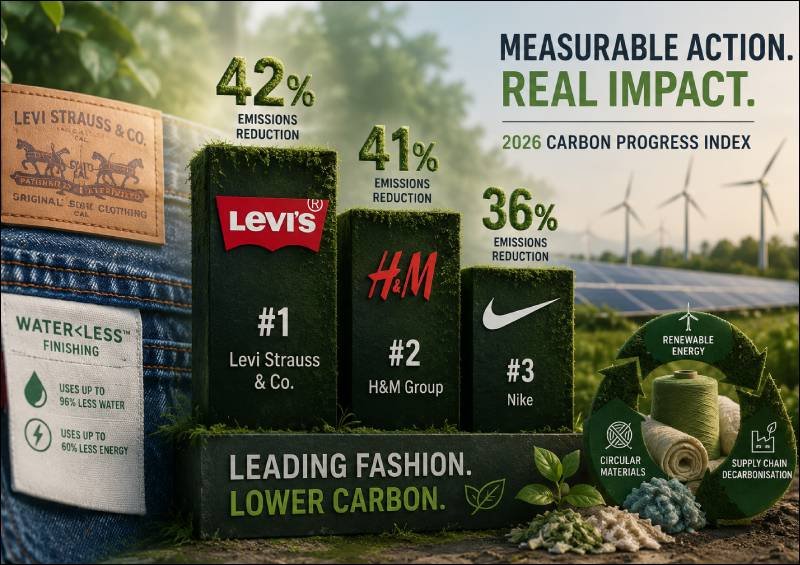
According to the 2026 Carbon Progress Index released by RetailBoss, Levi Strauss & Co., H&M Group and Nike have emerged as the industry’s top performers, driven by large-scale investments in renewable energy, circular materials and supply chain decarbonisation.
Levi Strauss topped the rankings with a 42% reduction in absolute carbon emissions, achieved through renewable energy adoption across its supply chain and the expansion of its Water<Less denim finishing technology, which significantly lowers water and energy consumption.

H&M Group followed closely with a 41% reduction in Scope 1, 2 and 3 greenhouse gas emissions from its 2019 baseline. The retailer’s progress has been supported by investments in textile-to-textile recycling infrastructure and the elimination of coal from its Tier 1 and Tier 2 supplier facilities, demonstrating that large-scale fashion businesses can reduce emissions while maintaining production volumes.
Nike ranked third after cutting Scope 3 emissions by 36%, supported by its Move to Zero strategy. The sportswear giant has incorporated recycled materials into approximately 70% of its footwear, helping reduce emissions while continuing to expand sales.
Among luxury companies, Kering recorded a 24% reduction in absolute emissions, using its Environmental Profit & Loss (EP&L) framework to identify and reduce high-impact processes across its supply chain. Fellow luxury group LVMH achieved a 13% reduction under its LIFE 360 sustainability programme by improving energy efficiency and increasing renewable energy use.
The report also highlighted progress by Inditex, parent company of Zara, which reduced emissions by 11% through greater use of sustainable fibres and greener logistics, although reliance on air freight continues to pose a significant challenge. Adidas reduced emissions by 10%, driven largely by its transition to recycled polyester across key product lines.
Other companies featured in the rankings include Lululemon, which reported a 29% reduction in emissions intensity, Stella McCartney, which achieved an 8% reduction through the adoption of next-generation biomaterials, and Patagonia, whose 2% emissions reduction reflects its long-standing strategy of extending product life through repair and reuse initiatives.
The report notes that brands recording emissions increases including several major global retailers, were excluded from the rankings, underscoring a growing emphasis on verified carbon reductions rather than sustainability commitments alone.
Industry shifts towards measurable climate action
The report identifies three defining trends shaping the fashion industry’s sustainability agenda in 2026.
First, companies are increasingly being judged on absolute emissions reductions, particularly across Scope 3 supply chain emissions, rather than relying on carbon offsetting or neutrality claims.
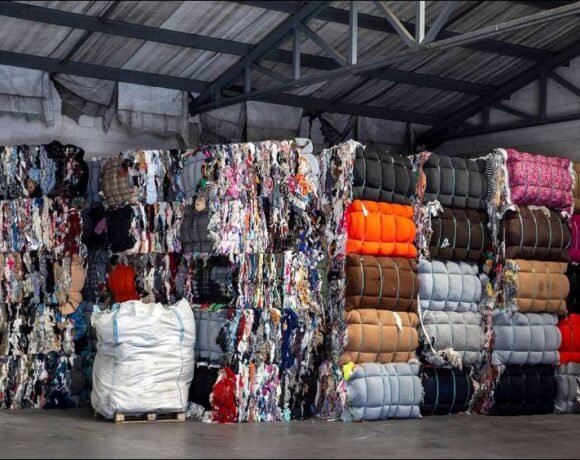
Second, circularity has become a key decarbonisation strategy, with leading brands embedding recycled materials into mainstream product lines instead of limiting them to niche collections.
Third, new disclosure requirements under regulations such as California’s SB 253 are raising expectations around supply chain transparency, requiring companies to provide independently verifiable emissions data and strengthening accountability across the global fashion value chain.
As regulatory scrutiny intensifies and buyers demand greater transparency, the report suggests that measurable carbon reductions, circular manufacturing and supply chain traceability are rapidly becoming competitive differentiators for global fashion brands.