
India-EU FTA May Open New Growth Avenue For Textile Industry
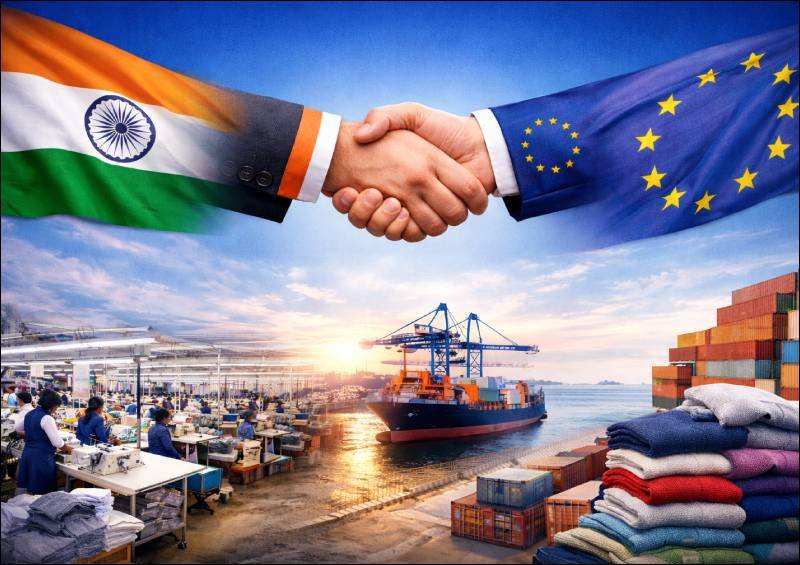
The proposed India-European Union Free Trade Agreement (FTA) could provide a major growth opportunity for India’s textile and apparel industry, with the sector stepping up engagement with European retailers, fashion brands and sourcing platforms ahead of the pact’s expected implementation early next year.
A high-level delegation from the Ministry of Textiles and leading industry bodies recently visited France and Italy, where it held discussions with major retailers, fashion houses and industry platforms. The engagements are aimed at strengthening India’s position in the European market and helping exporters better understand the sourcing requirements of global brands.
The scale of the opportunity is significant. The European Union imported textiles and apparel worth around US$ 292.8 billion in 2025, while India’s textile and apparel exports to the EU were approximately US$ 10.4 billion. The relatively small share highlights the considerable headroom for Indian companies to expand their presence in the bloc.

The proposed FTA is expected to provide preferential market access, including potentially zero-duty treatment across a substantial number of textile and apparel tariff lines. Such tariff benefits could improve the competitiveness of Indian products against suppliers from countries that already have preferential trade arrangements with the EU.
The potential opportunity covers a wide range of segments, including garments, home textiles, yarns, fabrics, technical textiles, made-ups and sustainable and recycled products.
However, industry experts point out that lower tariffs alone will not guarantee a significant increase in exports. European buyers are increasingly evaluating suppliers on parameters such as product quality, pricing, delivery speed, flexibility, regulatory compliance, sustainability, traceability and reliability.
The recent delegation’s meetings with retailers such as Monoprix and Okaidi, as well as luxury groups including Chanel and LVMH, indicate an effort to move Indian textile exports beyond traditional commodity-based sourcing. Greater engagement with international brands could help Indian manufacturers develop higher-value products and build longer-term sourcing relationships.
Another initiative under consideration is an India Immersion Centre in Milan. Such a platform could provide Indian exporters with greater exposure to European consumers, fashion trends, product development and sourcing practices, while helping international buyers better understand India’s manufacturing capabilities.
For India’s textile industry, the FTA could therefore represent more than a reduction in import duties. It could provide an opportunity to strengthen the country’s position across the European textile and fashion value chain.
Industry stakeholders will, however, need to use the tariff advantage to improve productivity, invest in technology and sustainability, develop differentiated products and strengthen compliance systems.
With Europe increasingly diversifying its sourcing base, the coming years could prove critical for India to move from being a cost-competitive supplier to a strategic, value-added and sustainable sourcing partner for European brands.