Bullrush Waste Converted Into Copper-Enhanced Material For Dye Removal
Researchers at Doshisha University, Japan, have developed a reusable adsorbent from bullrush agricultural waste that can remove both cationic and anionic synthetic dyes from industrial wastewater.
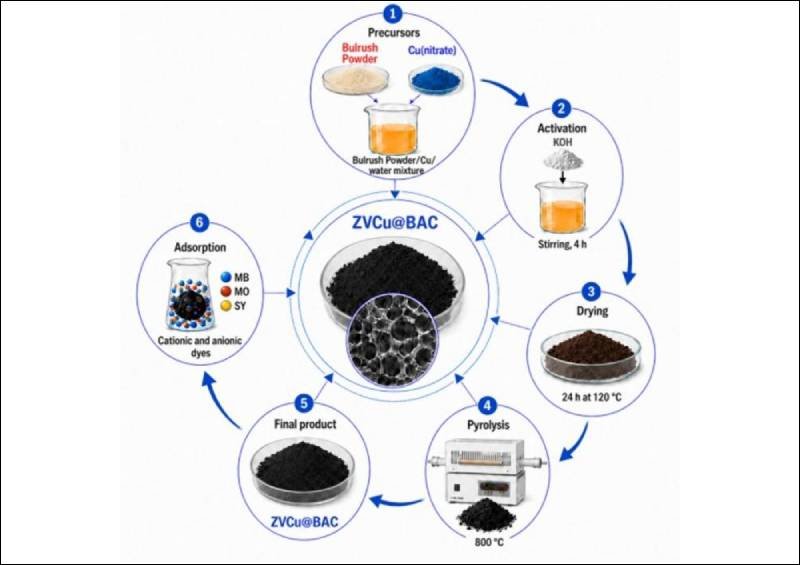
The researchers developed a zero-valent copper nanoparticle-enhanced bullrush activated carbon composite (ZVCu@BAC) through a single-step co-pyrolysis process. Laboratory tests showed that the material could effectively remove Methylene Blue (MB), Methyl Orange (MO) and Sunset Yellow (SY), while its regeneration performance and estimated production cost indicate potential for sustainable wastewater treatment.
Synthetic dyes discharged from textile manufacturing, paper production, leather processing and food industries are persistent in water and can pose risks to aquatic ecosystems and human health. Conventional treatment methods, including membrane separation and advanced oxidation, can involve high energy consumption, fouling, maintenance requirements and operating costs.

The research team, comprising Asif Ali, Ph.D. student and MEXT Scholar, Professor Michiaki Matsumoto and Professor Yoshiro Tahara of Doshisha University’s Department of Applied Chemistry, developed the composite using bullrush biomass as a carbonaceous precursor.
Copper (II) nitrate trihydrate and potassium hydroxide (KOH) were used to facilitate the in-situ formation of zero-valent copper (Cu0) nanoparticles. During co-pyrolysis, gases naturally generated from the biomass, including carbon monoxide and hydrogen, acted as reducing agents, eliminating the need for additional chemical reductants.
Characterisation using SEM, TEM, EDX mapping, FTIR, BET, XRD and TGA/DTA showed that the composite had a mesoporous structure, with Cu0 structures distributed across the carbon matrix. The material recorded a surface area of 984.5 m²/g and a total pore volume of 0.615 cm³/g.
In batch adsorption experiments, ZVCu@BAC recorded maximum adsorption capacities of 62.31 mg/g for Methylene Blue, 56.37 mg/g for Methyl Orange and 35.76 mg/g for Sunset Yellow. Its ability to treat both positively and negatively charged dyes was attributed partly to its amphoteric surface, with a point of zero charge of approximately pH 9.
The adsorption data were best described by the Langmuir isotherm, while pseudo-second-order kinetics indicated that chemisorption played a major role. The researchers identified electrostatic attraction, π–π stacking, pore filling and coordinate bonding with Cu0 sites as contributing mechanisms.
The composite also showed good regeneration performance. After six regeneration cycles using a 0.1 M KOH/acetone eluent, it retained 90.6% removal efficiency for Methylene Blue and 88.0% for Methyl Orange.
The production cost was estimated at approximately ¥1,800 per kg, supporting the potential economic advantage of using low-cost biomass as a raw material.
Prof. Matsumoto said the research could contribute to a circular economy by valorising invasive, zero-cost bullrush biomass into a functional carbon framework through an eco-friendly, single-step co-pyrolysis route.
The researchers said the material could be further investigated for mixed-dye wastewater treatment and other industrial applications.