
Can Chemical Recycling Unlock Circularity For Polyester Textiles?
European Commission Study Highlights the Promise and Challenges of Closing the Loop on Textile Waste
As the global textile industry races to meet ambitious sustainability targets, chemical recycling is increasingly being viewed as a critical technology for achieving true circularity, particularly for polyester-based textiles. A new report from the European Commission’s Joint Research Centre (JRC) suggests that while chemical recycling remains economically challenging today, it could play a vital role in transforming textile waste into a valuable resource in the years ahead.
The report, ‘Economic Viability of Chemical Recycling: Current and Future Perspectives’, examines the technical and economic performance of various chemical recycling technologies and their potential contribution to Europe’s circular economy objectives. For the textile sector, the findings underscore both the urgency and the opportunity surrounding polyester recycling.

The Polyester Recycling Gap
Polyester has become the dominant fibre in the global textile industry due to its affordability, durability and versatility. Yet despite its widespread use, polyester remains one of the least circular textile materials.
According to the report, less than one per cent of PET polyester fibres are currently recycled back into new fibres. Most end-of-life polyester textiles are either landfilled, incinerated or downcycled into lower-value applications, representing a significant loss of material value.
The challenge becomes even greater when dealing with blended textiles such as polyester-cotton fabrics, which account for a substantial share of global apparel production. Conventional mechanical recycling technologies struggle to separate and recover fibres from such blended materials, limiting their effectiveness in creating true textile-to-textile recycling systems.
Why Chemical Recycling Matters
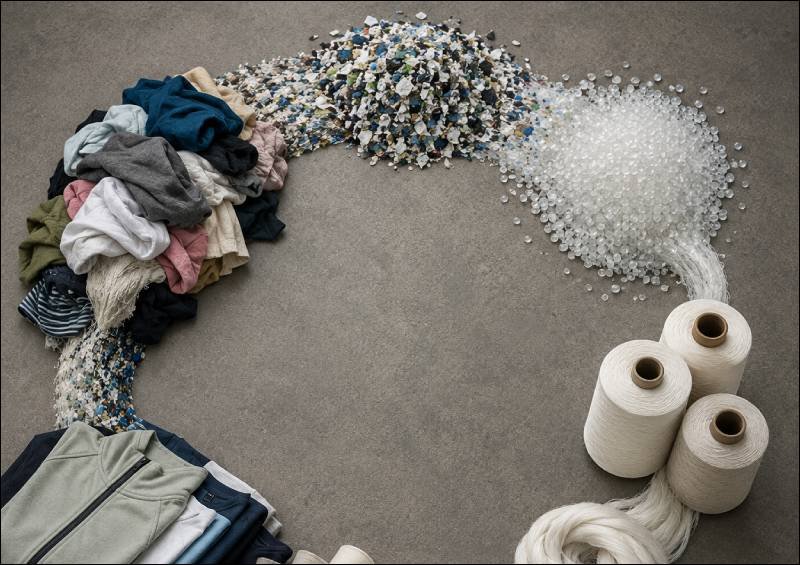
Unlike mechanical recycling, which can degrade fibre quality over multiple cycles, chemical recycling breaks polymers down into their molecular building blocks. These recovered monomers can then be used to manufacture new materials with properties comparable to virgin products.
The report identifies solvolysis as one of the most promising pathways for recycling PET and polyester textile waste. The technology uses solvents to depolymerize polyester into its constituent chemicals, enabling the production of high-quality recycled feedstock suitable for new textile applications.
This capability is particularly significant for the fashion and textile industry, where maintaining fibre quality is essential for product performance and consumer acceptance.
Industry Investment Accelerates
A growing number of companies are investing heavily in chemical recycling technologies aimed at closing the polyester loop.
Among the leading players highlighted in the report are Eastman, INEOS Infinia, Carbios and Gr3n. These companies are developing industrial-scale processes capable of converting polyester-rich waste streams into virgin-quality raw materials.
Several of these technologies are designed specifically to address one of the industry’s most persistent challenges: the recycling of mixed-material textiles. By recovering polyester from complex waste streams, chemical recycling could significantly increase the volume of textile waste that can be reintroduced into production cycles.
Economics Remain the Biggest Hurdle
Despite its technical promise, chemical recycling still faces significant economic challenges. The JRC report notes that chemical recycling generally remains more expensive than producing virgin plastics from fossil-based feedstocks. For PET recycling through solvolysis, costs are estimated at approximately U$ 2,150 ± US$ 500 per tonne, depending on technology configuration and operating conditions.
These costs are influenced by several factors, including energy requirements, solvent recovery systems, feedstock collection and sorting infrastructure and plant scale. As a result, many chemical recycling projects continue to rely on policy support, sustainability commitments from brands, or premium markets willing to pay for recycled content.
However, the report suggests that future regulatory measures could significantly improve the business case for chemical recycling. Increasing recycled-content requirements, extended producer responsibility schemes and stricter waste management regulations may help narrow the cost gap between virgin and recycled materials.
Implications for the Textile Industry
For textile manufacturers and brands, the report sends a clear signal: chemical recycling is moving from concept to commercial reality.
As governments and brands push toward circular business models, access to high-quality recycled polyester is expected to become increasingly important. Technologies capable of converting post-consumer garments and textile waste into virgin-equivalent raw materials could help the industry reduce its dependence on fossil-based resources while addressing growing concerns over textile waste.
The development is particularly relevant for regions such as Asia, which account for the majority of global polyester fibre production and textile manufacturing. Investments in collection systems, sorting infrastructure and recycling capacity could create new opportunities across the textile value chain.
The Road Ahead
While chemical recycling is unlikely to replace mechanical recycling entirely, the JRC report positions it as a critical complementary technology for achieving circularity in polyester textiles. Mechanical recycling will continue to play an important role where material streams are clean and homogeneous, while chemical recycling can help address complex and contaminated waste streams that are otherwise difficult to recover.
The path forward will depend on continued technological improvements, economies of scale and supportive policy frameworks. Yet the direction is becoming increasingly clear. As sustainability targets tighten and demand for recycled materials grows, chemical recycling may become one of the textile industry’s most important tools for transforming waste into a valuable resource.
For an industry seeking to balance growth with environmental responsibility, the question is no longer whether chemical recycling has a role to play, but how quickly it can be scaled to meet the demands of a circular textile economy.