India-UK FTA Opens New Opportunities To Boost Partnerships: BTMA CEO
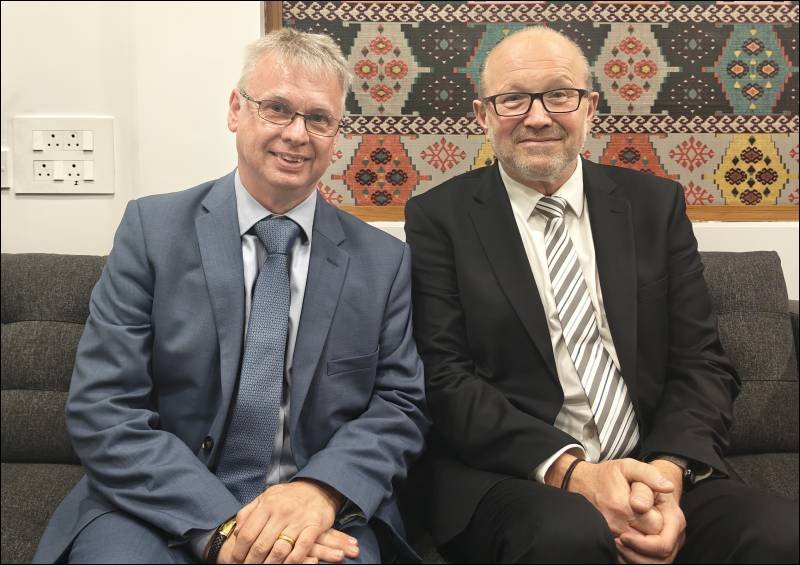
The India-UK Free Trade Agreement (FTA) is expected to strengthen collaboration between the two countries’ textile industries, creating new opportunities for technology transfer, machinery upgrades and sustainable manufacturing. In this exclusive interview with Textile Insights, Jason Kent and Mark Jarvis, discuss how the new UK-India textile machinery coalition aims to boost partnerships, support Indian manufacturers with advanced technologies and accelerate the industry’s move towards higher-value, sustainable production.
The India-UK FTA has finally been signed after years of negotiations. How significant is this agreement for the textile machinery sector?
Jason Kent: The FTA is a landmark moment. For years, it remained a topic of discussion, but now it is real. More importantly, it restores trust and creates an environment where both countries can collaborate rather than compete through trade barriers.
Tariffs have increasingly been used as economic weapons around the world. The FTA signals a move in the opposite direction, it encourages cooperation and allows industries in both countries to grow together.

India’s economy is expanding at around 6.5 per cent, making it one of the world’s most exciting growth markets for UK textile machinery. Historically, many machines installed in India came from Britain, although over time Italian and German manufacturers gained market share. We now see an opportunity to rebuild those relationships.
The UK has strong capabilities in technical textiles, textile testing and advanced fibre manufacturing, which perfectly complement India’s ambition to move into higher-value textile products. India has the resources, the talent and the appetite to become a global leader in these segments.
The FTA is the catalyst. The real challenge now is turning the agreement into measurable outcomes.
Following successful collaborations like Strayfield and Moonga, do you expect more UK-India technology partnerships?
Jason Kent: Absolutely. Technology partnerships are becoming easier because both sides have gained valuable experience over the years. Every new technology brings expectations, and naturally there are challenges during implementation.
Success depends less on the technology itself and more on how suppliers and customers work together to solve problems instead of blaming each other.
India has always been a collaborative partner for the UK. We share a long industrial heritage, and there are numerous examples of successful cooperation. We would much rather build partnerships with India than with many other markets because there is mutual trust and a genuine willingness to innovate together.
What strategic gap does the UK-India textile machinery coalition aim to address?
Jason Kent: The biggest gap is communication. Many UK companies want to do business with India but often perceive export regulations and market entry as complicated. Our members are engineers, not policy experts.
The coalition exists to bridge that gap by connecting the right industrial partners, academic institutions and technology providers. It is much more than a networking platform. It is about enabling collaboration and making business easier.
Mark Jarvis: Another major opportunity lies in machinery upgradation. Indian manufacturers have invested heavily in capital equipment over the past decade and much of that machinery still has years of productive life ahead. Rather than replacing entire production lines, UK technology can help modernise existing equipment to meet evolving sustainability, traceability and regulatory requirements at a much lower cost.
How can UK technology help Indian mills improve sustainability and operational efficiency?
Jason Kent: Sustainability should never be viewed as simply buying new machinery. Technology is only a tool. The real challenge is understanding the problem before choosing the solution.
Many sustainability projects fail because companies invest in technology without analysing their factories, supply chains, workforce capabilities or long-term market strategy.
At BTMA, we don’t simply represent machinery manufacturers. We represent the knowledge, infrastructure and expertise behind those technologies.
We want Indian mills to choose the right technology, not just the newest one. Sometimes the best solution isn’t replacing machinery but improving processes, upgrading skills or redesigning workflows. Our role is to help manufacturers avoid costly mistakes and ensure investments deliver genuine long-term value.
Indian textile manufacturers are often criticised for prioritising cost over quality. How do you view this challenge?
Jason Kent: It’s ultimately about education and changing mindsets. Companies need to ask themselves a simple question: What happens if I don’t invest? Buying the cheapest solution doesn’t necessarily deliver the desired outcome.
We’re already seeing a generational shift, particularly among younger business leaders, who increasingly view sustainability as a core business value rather than an additional expense. Over time, that mindset will become more widespread.
Mark Jarvis: I don’t see cost consciousness as a weakness. Every developing textile industry goes through this phase. China experienced the same transition over the last three decades before moving towards higher-value manufacturing.
India is now approaching a similar tipping point. If India wants to continue growing globally, it must move beyond cost competitiveness and focus on value addition, technology upgradation and product differentiation.
What outcomes do you expect from this alliance over the next two to three years?
Jason Kent: Success should be visible rather than discussed. We want the industry to say that this coalition genuinely helped companies achieve tangible results.
For me, success will be measured through very practical indicators:
- More BTMA member companies exhibiting at India ITME and ITMA.
- Higher UK machinery sales into India.
- More successful UK-India technology collaborations.
- Indian manufacturers achieving measurable business growth through UK technology.
We are a not-for-profit organisation. Our objective is not commercial gain, it is enabling industry success.
Mark Jarvis: I would consider the alliance successful if Indian manufacturers become more competitive by leveraging UK technology, expertise and knowledge. Ultimately, their success will be our biggest achievement.