Is Viscose The New Polyester?

The fibre changed. The system did not. And the industry pays every time.
Before polyester, fashion’s fibres were expensive, labour-intensive and geographically constrained. Silk came from China. Wool came from farms. Cotton needed land and water. The supply chain was slow, and the product was priced accordingly.
Then polyester changed the economics of the entire industry. Silk became polyester. Wool became polyester. Cotton blends became polyester blends. Cheap, scalable, wrinkle-resistant and derived from petroleum — polyester made fast fashion possible. For two decades it was fashion’s answer to everything: speed, volume, variety and a price point that put trend-driven clothing within reach of mass markets.

Then it developed an image problem. Consumers began connecting polyester to plastic, to microplastics, to fossil fuels. The fibre that built fast fashion became its most visible liability.
Now polyester is becoming viscose.
Today, viscose sits at approximately 10 per cent of total assortment at both Zara and H&M — and significantly higher in the summer dresses, satin skirts and occasion-wear categories where polyester drew the most consumer backlash. A review of womens-wear collections across Zara, Mango, and H&M in April–May 2026 showed viscose or viscose-blend compositions appearing more frequently than cotton across multiple summer categories. Man-made cellulosic fibres as a family — viscose, rayon, modal and lyocell — grew from 7.9 million tonnes in 2023 to 8.4 million tonnes in 2024. The transition is no longer niche. It is becoming the new default.
II. THE SUBSTITUTION
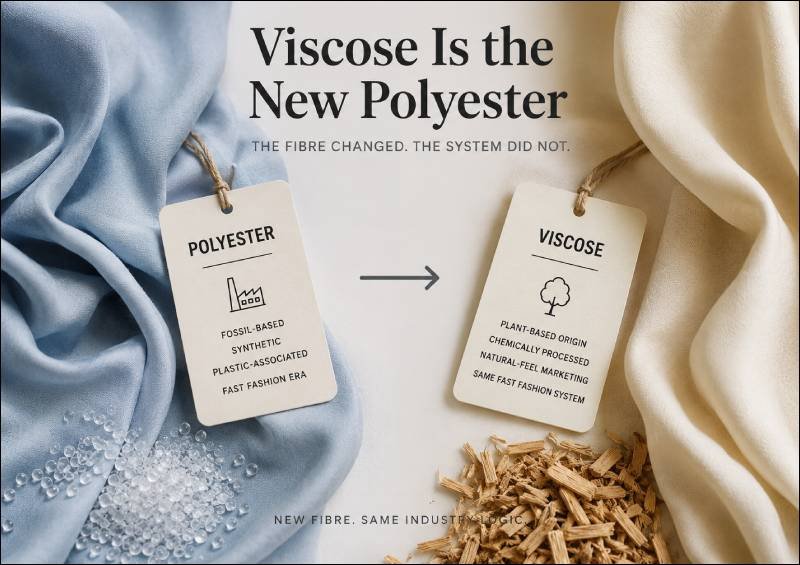
Viscose is plant-derived. It originates from wood pulp. It drapes well, photographs well for digital retail, and feels cooler than polyester in warm climates. The marketing vocabulary shifted: natural origin, breathable, soft hand. The word forest appeared in brand copy. The associations with fossil fuels did not transfer.
Many consumers have read this transition as progress. Natural origin implies lower environmental impact. That reading does not survive contact with the chemistry.
III. NATURAL ORIGIN, INDUSTRIAL REALITY
Viscose begins with trees. Wood pulp — sourced from managed plantations or, in problematic supply chains, from ancient and endangered forests — is chemically dissolved and regenerated into fibre through a process that is energy-intensive, water-intensive and chemically demanding.
Traditional viscose manufacturing relies on carbon disulphide, a solvent linked to elevated rates of coronary disease, birth defects and neurological harm in workers and in communities near production facilities. The Changing Markets Foundation documented pollution at viscose production hubs in China, India and Indonesia — waste-water discharge, chemical exposure, health impacts in surrounding areas. In 2017, H&M was buying directly from seven of the investigated facilities. Zara from four.
Viscose also illustrates the limits of judging a material by its source alone. Conventional viscose can lose strength when wet, shrink with washing, lose shape over time, and pill with repeated wear. Its useful life is often shorter than the natural fibres it is designed to imitate — silk, cotton, linen — which means a renewable fibre origin does not automatically mean lower resource consumption over the garment’s lifetime. A material that needs replacing more frequently drives consumption in its own way. Sustainability is determined by the full arc of a garment’s life: how it is processed, how long it remains in use, and what happens to it at the end of life — not only where the fibre came from.
The forest pressure is structural, not incidental. Canopy estimates that approximately 200 million trees are logged annually for textile production, with up to 30 per cent of viscose and rayon originating from ancient or endangered forests. Its 2024 Hot Button Report found that 29 per cent of global man-made cellulosic fibre producers still hold ratings indicating elevated forest risk — and that demand for these fibres grew by nearly half a million tonnes in a single year, with a disproportionate share of that expansion coming from producers with the worst environmental scores.
Viscose accounts for roughly 80 per cent of all man-made cellulosic fibre produced globally. It is not a niche material. It is the standard.
IV. THE PATTERN
The fashion industry has done this before.
A material is adopted for practical and commercial reasons. It is scaled within a system that rewards speed and volume. Its environmental costs become visible. The industry finds a new material that performs the same commercial function under a different vocabulary — one that provides cover from criticism without changing the underlying model.
The Ellen MacArthur Foundation has documented this structural problem directly: inserting a new fibre into a system that produces over 100 billion garments annually, while garment utilisation rates continue to fall, does not create circularity. It relocates extraction pressure from one system to another.
Polyester depended on oil. Poorly sourced viscose depends on forests. Different resource. The scale dynamics are the same.
The question is not whether viscose is better or worse than polyester in isolation. The question is whether replacing polyester with viscose — at the same production volumes, the same consumption speeds, the same business model — is a sustainability transition or a perception transition.
A garment marketed as natural in origin may still be processed with industrial solvents, blended with polyester or elastane in ways that make end-of-life recycling impossible, and designed for a lifespan of months. The material narrative evolved. The system did not.
Viscose may face its own backlash — around deforestation risk, chemical processing, and the fact that viscose-elastane blends are as difficult to recycle as many polyester blends. When that awareness builds, something else will replace viscose. The collection mix will shift again.
Every season, the order mix changes. The industry already knows this. What is less often stated is what that cycle actually costs — and who pays it.
V. WHO PAYS THE SWITCHING COST?
The manufacturer does.
Every time a brand pivots to a new fibre, the supply chain absorbs the transition: new raw material sourcing, new processing parameters, new certifications, and new quality standards. The investment built around one fibre does not transfer cleanly to the next. That cost rarely appears in a sustainability report.
The cost runs deeper than the factory floor. Processors who invested in viscose-specific finishing chemistry, spinners who built supply relationships around cellulosic yarn, testing labs and certification bodies that developed viscose-specific protocols — all of these absorb a version of the same cost. When the collection mix shifts again, that infrastructure does not pivot cleanly. It waits, or it writes off the investment, or it follows the next fibre and starts the cycle all over again.
India’s Panipat recycling cluster has been pricing one version of this cost for decades. Blended fabrics — viscose with elastane, viscose with polyester — cost more to sort, yield less recoverable fibre, and often cannot enter any recycling stream. The brand that specified the blend moved on. The recycler is left with the problem.
Viscose is the industry’s current answer to polyester’s image problem. It is a good answer for the brand. The supply chain reorganised to deliver it. It will reorganise again when the next answer is required.
The question worth asking is not which fibre comes next.
It is why the cost of every transition falls on the industry that manufactures.
The industry has always known how to respond when a fibre runs out of goodwill.
The question is whether it will ever get ahead of that cycle — or keep absorbing the cost of catching up.