Weaving A Circular Future For India’s Textile Waste
For decades, the textile industry has been a cornerstone of craftsmanship, employment and economic growth. Yet alongside this progress, textile waste has emerged as one of the sector’s most pressing environmental challenges. Globally, an estimated 92 million tonnes of textile waste is generated annually, while less than 1% of used clothing is recycled back into new garments.
These numbers underscore the urgent need to rethink how textiles are produced, consumed and managed. More importantly, they present a powerful opportunity to embrace recovery, reuse and regeneration.
At the International Fashion Business Exchange Council (IFBEC), this transition is seen not merely as an environmental imperative but as a strategic opportunity to align economic growth with sustainability and social impact. IFBEC believes the textile industry must move decisively from a linear consumption model to a circular economy built on resource efficiency.

The Maharashtra Model: A Blueprint for Circularity
The urgency of this shift is increasingly visible across Maharashtra, where changing consumption patterns are contributing to mounting textile waste. Discarded garments frequently end up clogging drains, blocking sewage systems during monsoons and filling already burdened landfills.
Recognising this challenge, the Maharashtra government has introduced the Integrated Sustainable Textile Industry Policy 2023–28, centred around the three Rs – Reduce, Reuse and Recycle.
As part of this initiative, the state is offering capital subsidies of up to 50 per cent, or ₹2 crore, for recycling machinery investments. Under this progressive framework, Maharashtra’s first Domestic Post-Consumer Textile (DPCT) recycling project is being established in Bhiwandi. Already, 200 tonnes of old cloth have been stockpiled for the project.
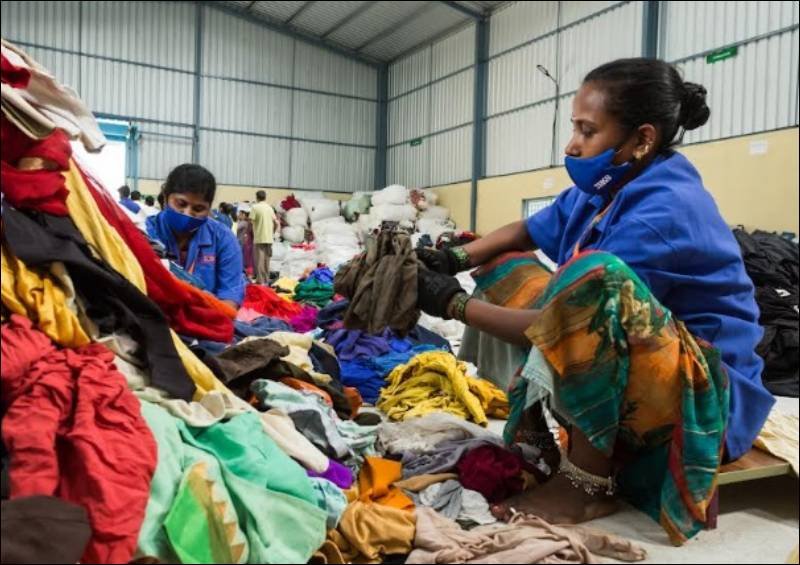
According to IFBEC founders, this collection effort is currently community-driven, with waste being sourced directly from households through organised collection drives and designated drop-off points. Segregation is being carried out by trained women workers, ensuring both sorting precision and meaningful local employment generation.
As the project scales, AI-powered sorting systems are expected to be integrated to improve operational efficiency and enhance material classification accuracy.
The objective is to convert domestic post-consumer textile waste into entirely new products while retaining maximum value within the textile ecosystem. Particularly promising are ongoing pilot initiatives focused on transforming recycled fibres into high-performance technical textiles, a segment widely viewed as a significant future growth driver.
Building India’s Recycling Infrastructure
The Bhiwandi facility will initially deploy advanced mechanical recycling technology.
After evaluating globally proven recycling solutions, IFBEC has identified an Indian machinery manufacturer as one of its technology partner, combining international best practices with indigenous engineering capability.
This hybrid approach aims to create a scalable and robust foundation for processing current feedstock while creating opportunities for future technological upgrades.
The Bhiwandi project is intended to serve as the flagship proof of concept under Maharashtra’s broader roadmap, which outlines plans for 12 recycling plants across the state.
According to IFBEC, the immediate focus is ensuring Bhiwandi successfully demonstrates commercial viability by generating market-ready products.
Once this model is validated, it is expected to encourage wider industry participation in establishing the remaining plants.
Industry observers note that given the sheer scale of textile waste generation, Maharashtra’s eventual recycling infrastructure requirements are likely to extend well beyond the current target.
Building an Integrated Reverse Value Chain
A key challenge in textile circularity remains the disconnect between waste generation and recovery.
Large volumes of reusable material continue to lose value due to fragmented collection systems, inadequate segregation and limited recycling infrastructure.
To address this, IFBEC has established the Responsible Fashion Collective, a collaborative platform that brings together local waste collectors, upcyclers and recyclers to build an integrated reverse value chain.
The initiative aims to formalise textile waste collection while creating an inclusive ecosystem that integrates municipalities, waste handlers and informal-sector workers.
The long-term vision is to replicate this collective model across Maharashtra and eventually scale it nationally.
Collaboration as the Catalyst
IFBEC emphasises that circularity cannot be achieved in isolation.
The organisation is actively inviting technology providers, innovators, researchers, entrepreneurs and established industry stakeholders to collaborate on scalable recycling solutions.
This open collaborative framework reflects IFBEC’s belief that meaningful transformation requires collective participation.
As Europe demonstrates through Extended Producer Responsibility (EPR) frameworks and advanced fibre-to-fibre technologies, systemic change is possible when policy, technology and industry alignment come together.
India now has an opportunity to build its own circular textile blueprint, one that is scalable, inclusive and rooted in local realities.
The future of textiles will not be defined solely by what the industry produces, but by how effectively it recovers, reuses and regenerates the resources already within its ecosystem.
Textile waste must no longer be viewed as an endpoint, but as a valuable resource waiting to be reintegrated into the economy.
By shifting our collective mindset from disposal to recovery, India can transform today’s waste into tomorrow’s catalyst for innovation.
(From the Founders’ Desk, International Fashion Business Exchange Council)