‘Recycling Was Always Last. Someone Moved It To The Front’

In this incisive and insightful article penned exclusively for Textile Insights, Mansi Bihani writes that the carbon footprint of recycling is not zero, it is simply lower than producing virgin material from scratch, which is a meaningful difference but not the same as being without cost.
On World Environment Day, it is worth asking what we were actually taught and what was done with it since.
Most of us learnt it early. Reduce. Reuse. Recycle. It was on classroom walls, in school projects, printed on the back of packaging. Recycling felt like the right response to an environmental problem – visible, actionable, something a child could do. You separated your paper from your plastic. You put the bottle in the correct bin. You were participating.
That instinct was not wrong. Recycling does recover material. It does reduce some demand for virgin resource. It is better than landfill. The problem is not what recycling is. The problem is what it became and over time, that understanding quietly shifted.

Open any major apparel brand’s website today. Somewhere in the product description, sometimes as a badge, sometimes as a headline, you will find it: Made from 30% recycled content. Part of our circular collection. Made with recycled fibres. The label is real. The implication attached to it that buying this product is an environmental act, that the percentage is a kind of permission is not.
This is what has happened to recycling over the past two decades. It was taken from the end of a carefully ordered sequence, placed at the front of a marketing strategy and often used to support production models that the original hierarchy was designed to question. A consumption permit dressed in the language of environmental responsibility.
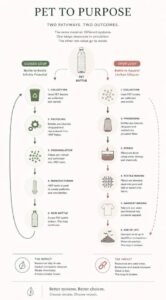
The recycled polyester example makes this concrete. A PET bottle can become another PET bottle almost indefinitely, the chemistry of bottle-to-bottle recycling is mature and commercially viable. The moment that bottle becomes a polyester garment, it passes through dyeing, blending, chemical finishing, and mechanical processing that makes recovery to bottle-grade material practically impossible. The bottle has permanently left its closed loop. The recycled content claim on the garment is accurate. The circularity claim is not. These are different statements, and the industry uses them as though they are the same.
But the deeper problem is not even that recycling is imperfect. It is that recycling was never designed to be the first response. There was a reason it appeared at the end of the hierarchy — and that reason is worth stating plainly, because it has been quietly forgotten.
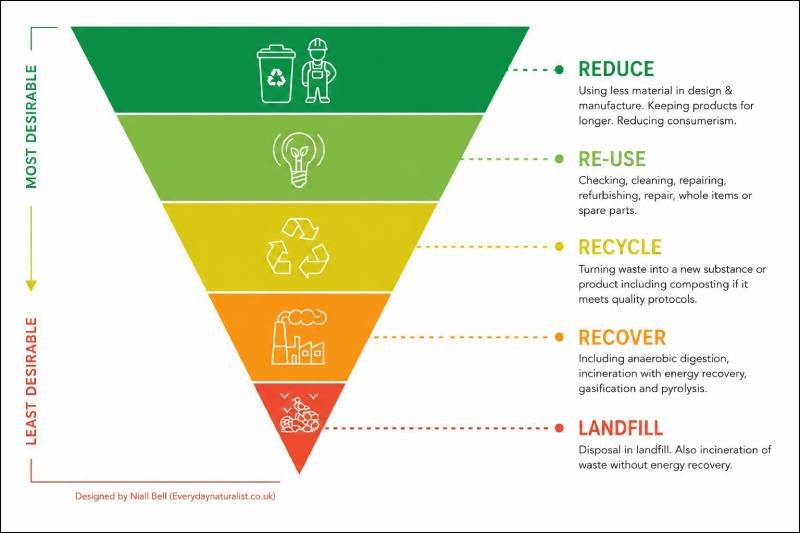
Expanded sustainability frameworks often place waste management within a broader sequence: Refuse, Reduce, Reuse, Repair, Repurpose, Remanufacture, and finally Recycle. The order is not arbitrary, and it is not a ranking of moral virtue. It is a ranking of resource efficiency – environmental, social and material. Each step higher in the sequence saves more than the one below it, because it works with what already exists rather than processing what has already been wasted.
 Refusing an unnecessary product preserves everything embedded in the material that was never extracted – the water, the energy, the land, the labour. Nothing has to be recovered because nothing was spent. Reducing consumption extends the value already created without consuming additional input. Reusing a garment costs nothing in new resource, the object moves, the material stays in use, the system does not have to process anything. Repairing it extends that logic further. Each of these interventions is cheaper to run, lower in environmental cost, and higher in recovered value than any downstream recovery process.
Recycling, by contrast, is energy-intensive. It requires collection infrastructure, transportation, sorting, mechanical or chemical processing, and in many cases, re-finishing before a recovered material can re-enter production. Heat, water and chemical inputs are consumed at every stage. The carbon footprint of recycling is not zero, it is simply lower than producing virgin material from scratch, which is a meaningful difference but not the same as being without cost. When a brand places a recycled content label on a product and calls that circularity, the energy and resource consumed in the recycling process are invisible. The label carries none of that weight.
Recycling was placed at the end of the hierarchy because the people who designed the sequence understood this. It was not a consolation prize. It was an acknowledgement that some material would inevitably reach end-of-life despite every earlier intervention — and that recovering it was better than disposal. It was the last line of defence, not the opening move.
World Environment Day is a reasonable moment to sit with what that classroom lesson actually contained. The three Rs were a simplification useful for children, accurate as far as it went. What the simplification dropped was the sequence, and the sequence was the point. Reduce before you reuse. Reuse before you repair. Repair before you recycle. And recycle only after everything else has been tried.
The instinct to put something in the right bin was never wrong. The mistake was allowing that instinct to be captured, scaled and sold back as permission to fill more bins.
(Mansi Bihani is a Textile Materials Expert and Founder of Pura Materials)