When Small Machines Quietly Build A Hidden Economy

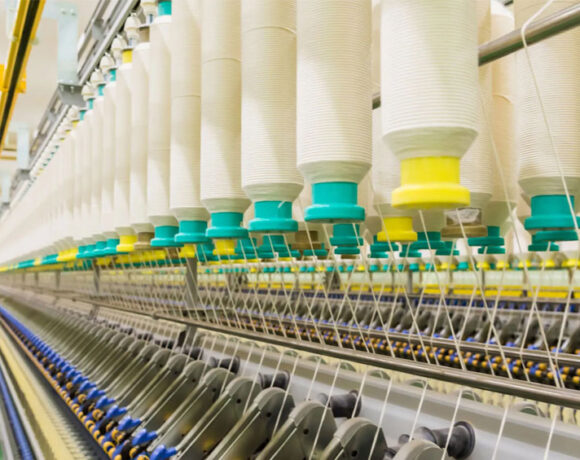
In many parts of the world, industrial growth is often imagined through large factories, massive investments and organised manufacturing clusters.
The United Kingdom presents a very different picture.
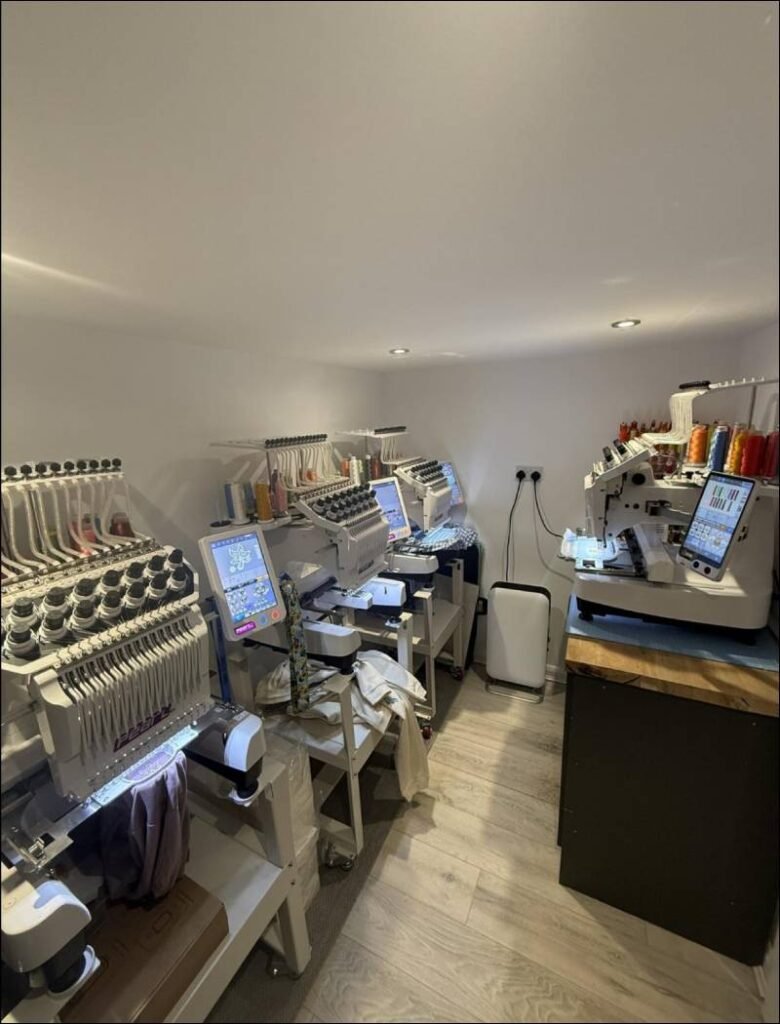
Over the last few years, an interesting shift has quietly taken shape across cities and towns throughout the UK. Not inside large industrial parks—but inside garages, spare rooms, home studios, tailoring units, sportswear workshops, and small independent boutiques.

Embroidery, in this environment, is not operating as a traditional manufacturing industry.
It is operating as a creator economy.
Small entrepreneurs—many with no formal industrial background—are building businesses around customisation, branding, local identity, sports culture and niche fashion. Some focus on logo embroidery for local businesses and clubs. Others work on personalised sportswear, schoolwear, workwear, Asian garments, boutique fashion or small-batch premium designs.
Most of these businesses are not large enough to appear in industrial statistics.
Yet together, they form a remarkably active ecosystem.
What makes this even more interesting is that many of these entrepreneurs are not entering embroidery through conventional industry channels. They are not attending major machinery exhibitions. They are not guided by industrial consultants or government programmes.
Many simply discover an opportunity through social media, local demand or online customisation trends—and decide to build something of their own.
And once one succeeds, another follows.
Over time, this has created a growing support ecosystem around embroidery itself. Machine suppliers are no longer only selling equipment—they are increasingly involved in installation, training, servicing, design support, accessories and business guidance. As demand expands across regions from England to Scotland and Ireland, local service structures are also evolving to support these growing users.
The result is not just more machines being sold.
It is the creation of thousands of small, independent income-generating activities operating beneath the visibility of mainstream industry discussions.
What is equally noticeable is the shift in demand itself.
Earlier, standard embroidery machines were sufficient for most applications. Today, there is increasing interest in customised setups, specialised attachments and machines adapted for niche creative work. Buyers are no longer only asking how fast a machine runs.
They are asking: “What more can this machine help me create?”
That question changes the entire direction of the business.
What is even more interesting is how these small operators interact with each other.
In many traditional industries, specialised work is often protected closely. Techniques, attachments and niche applications become guarded advantages.
Yet in several parts of the UK embroidery market, a different behaviour is becoming visible.
 Small business owners are learning together.
Operators working on shoes, socks, handbags, caps, boutique fashion and customised accessories are increasingly sharing experiences, testing ideas collectively and even helping each other access specialised frames, attachments and techniques.
In some cases, customers join online sessions together—openly discussing applications that would traditionally be treated as competitive advantages.
The mindset is noticeably different.
The focus is not only on protecting an idea, but on expanding the market itself.
There is an understanding that creativity will always remain individual, even if techniques become shared.
And perhaps that is another important shift modern industries are quietly teaching us:
In emerging creator-driven economies, collaboration is not weakening competition.
It is accelerating expansion.
In many ways, the UK embroidery market demonstrates something larger than embroidery itself.
It shows how modern economies are increasingly being shaped—not only by large industries—but by decentralised creators, specialised small businesses, and individuals building niche capabilities around local demand.
These may not always be large factories.
Some may never even become MSMEs in the traditional sense.
But collectively, they are quietly contributing to employment, creativity, local commerce, and economic activity in ways that often go unnoticed.
And perhaps that is the more important insight.
Sometimes, industries do not grow loudly.
They grow quietly—through thousands of individuals who simply decide to begin.
(About the Author)
Dashan is a global embroidery industry professional working across markets in Africa, the Middle East, South Asia, Southeast Asia, Europe and the Americas. With exposure to more than 96 countries, his insights are drawn from real-world industry experience, focusing on how embroidery integrates into practical business environments.