
Weaving Circularity Into India’s Textile Future
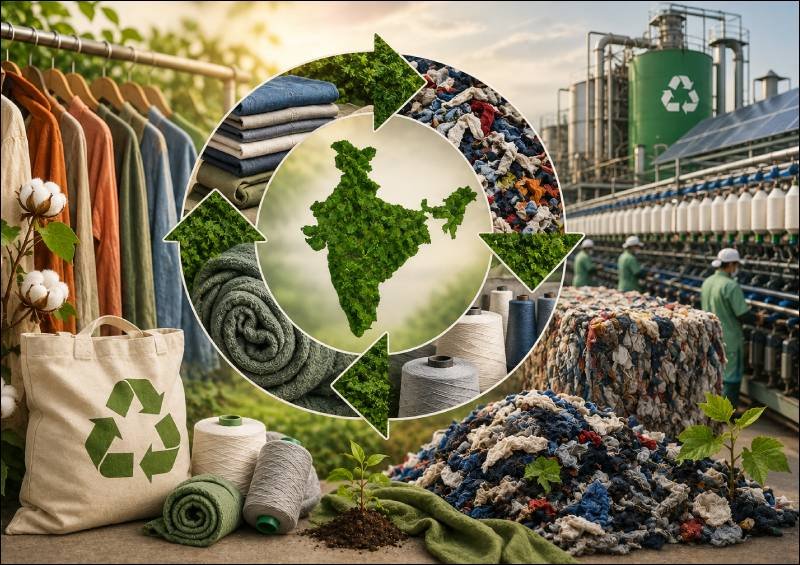
Sustainability is no longer a niche agenda for India’s textile industry. As global markets demand greater transparency, traceability and environmental responsibility, circularity is emerging as a strategic imperative for the sector’s next phase of growth.
India’s textile and apparel industry has long been one of the country’s most important economic pillars. Contributing around 2 per cent to GDP, 11 per cent to manufacturing GVA and providing direct employment to more than 45 million people, the sector remains central to India’s industrial and export ambitions. As the world’s sixth-largest exporter of textiles and apparel, India now finds itself at a crucial juncture where sustainability is becoming as important as scale and competitiveness.
The shift is being driven by changing consumer preferences, increasingly stringent global regulations, ESG commitments and the growing demand for environmentally responsible products. For India, this transition is not merely about compliance, it represents a significant opportunity to strengthen its position in global textile trade while building a more resilient and resource-efficient industry.

Circular Economy Moves Centrestage
At the heart of this transformation is the concept of a circular economy, an approach that seeks to keep materials in use for as long as possible through reuse, recycling and resource recovery.
While circularity has become a global buzzword, India already possesses many of its fundamental characteristics. Traditional practices of repairing, reusing and repurposing textiles have existed for generations. Today, these practices are being formalized and scaled through technology, policy support and industry collaboration.
The numbers are encouraging. India manages an estimated 7.8 million tonnes of textile waste annually, with more than 70 per cent already being recovered through recycling, upcycling, downcycling or reuse channels. Recovery rates are particularly high in the pre-consumer segment, where nearly 95 per cent of textile waste generated during manufacturing is collected and reused. The spinning sector offers one of the strongest examples of circularity, with almost all spinning waste being reintegrated into production streams.
Beyond environmental benefits, this ecosystem supports approximately 4 to 4.5 million livelihoods, many of them involving women from marginalized communities engaged in collection, sorting and redistribution activities.
Emerging Models of Textile Waste Recovery
Several Indian clusters are demonstrating how circularity can be translated into viable business models.
Navi Mumbai’s Textile Recovery Facility has emerged as one of the country’s pioneering municipal initiatives focused on textile waste. By integrating collection, sorting, upcycling and livelihood generation, the facility has successfully processed thousands of textile items while engaging more than one lakh households in circular economy practices.
Meanwhile, Panipat continues to strengthen its position as India’s largest textile recycling hub. Handling between 3,500 and 5,250 tonnes of textile waste per day, the cluster has become a critical downstream processing centre for textile waste generated across the country. The scale of operations presents substantial opportunities for higher-value textile-to-textile recycling.
Delhi’s Mongolpuri textile waste market provides another example of how informal networks contribute to circularity. Here, textile cutting waste is sorted by colour and quality before being supplied to formal recycling units, creating an important link between collection and value-added recycling.
Building Sustainability from Fibre Up
Sustainability begins at the source. Recognizing this, policymakers are increasingly focusing on organic fibres, alternative natural fibres and cleaner raw material inputs. Programmes such as the National Programme for Organic Production (NPOP), Jute-ICARE and the New Age Fibre Mission are designed to promote certified organic fibres, improve fibre quality and encourage sustainable cultivation practices.
The growing interest in fibres such as ramie, flax and sisal reflects a broader effort to diversify India’s fibre basket with materials that offer lower environmental footprints while meeting performance requirements across multiple applications.
At the same time, the industry is taking steps to reduce dependence on hazardous chemicals. Projects aimed at eliminating harmful chemicals from textile supply chains are already underway across several manufacturing clusters, covering hundreds of factories and major fashion brands. These initiatives seek to reduce chemical usage, improve environmental performance and align Indian manufacturing with international sustainability standards.
Greener Manufacturing Takes Shape
The production stage remains one of the most resource-intensive segments of the textile value chain, consuming significant quantities of water, energy and chemicals.
To address these challenges, sustainability has been embedded into major infrastructure initiatives such as the PM MITRA Parks. Designed around the Farm-to-Fibre-to-Factory-to-Fashion-to-Foreign (5F) vision, these integrated textile hubs incorporate common effluent treatment plants, wastewater recycling systems and shared environmental infrastructure. Seven PM MITRA Parks have already been approved across India, with investments exceeding Rs 27,000 crore committed through various MoUs.
Support for MSMEs is also expanding through programmes such as MSE-GIFT and MSE-SPICE, which encourage adoption of green technologies, resource-efficient production systems and circular economy solutions through interest subsidies and capital support.
In parallel, the textile industry is increasingly being integrated into India’s broader climate strategy. Under the Indian Carbon Market framework, textile companies are being encouraged to monitor and reduce greenhouse gas emissions, with carbon credit mechanisms providing financial incentives for improved environmental performance.
Recycling as the Next Growth Opportunity
India’s textile recycling sector is projected to become a major growth engine in the coming years. Industry estimates suggest the market could reach US$ 3.5 billion by 2030 while generating nearly 100,000 green jobs. The increasing focus on waste mapping, recycling infrastructure and resource recovery is expected to unlock significant economic value from materials that were previously discarded.
Policy support is also strengthening. The Solid Waste Management Rules 2026 introduce stronger circular economy principles and extended producer responsibility mechanisms while encouraging greater use of refuse-derived fuel generated from non-recyclable waste streams, including textiles.
Meanwhile, under the National Technical Textiles Mission, several R&D projects are exploring innovative ways to convert textile waste into advanced materials, including carbon fibres and functional textiles.
Market Recognition for Sustainable Textiles
Circularity and sustainability increasingly influence purchasing decisions, particularly in export markets. Initiatives such as the Eco-Mark Scheme, Kasturi Cotton and Silk Mark are helping strengthen the global positioning of Indian textile products through certification, traceability and sustainability assurance. These measures enhance buyer confidence while supporting responsible sourcing and transparent supply chains.
Public procurement is also becoming a catalyst for circularity. A tripartite agreement involving the Textiles Committee, Government e-Marketplace (GeM) and SCOPE aims to create market opportunities for upcycled products, encouraging greater adoption of circular business models.
Industry-led initiatives such as SU.RE (Sustainable Resolution) and awareness campaigns like Circle Back are further helping embed sustainability into business practices and consumer awareness.
The Road Ahead
India’s textile industry stands at a pivotal moment.
The country already possesses many of the ingredients necessary for a successful circular textile ecosystem: a large manufacturing base, strong recycling networks, entrepreneurial clusters, policy support and a cultural tradition of resource-conscious consumption.
The challenge now is to scale these strengths through investment, innovation and collaboration.
As global brands increasingly prioritize sustainability, traceability and circularity, India’s textile sector has an opportunity to transform environmental responsibility into a source of competitive advantage. The future of Indian textiles will not be defined solely by production volumes or export numbers, but by how effectively the industry can combine growth with resource efficiency, innovation with responsibility and tradition with sustainability.
In that journey, circularity is no longer an option, it is becoming the foundation of India’s next textile growth story.