
The Cotton Story: Who Decides What Goes Into Your Clothes?

For nearly two centuries, the country that grew some of the world’s finest cotton was not allowed to make much cloth from it. Colonial law taxed Indian-woven textiles until British mills in Manchester could undersell them — raw cotton left Indian ports one way and came back the other—spun, woven and priced by someone else.
When the freedom movement needed a symbol, it did not reach for a dove, a laurel tree, or an olive branch — the emblems other movements have used to signal peace or hope. It reached for a spinning wheel. A charkha does not represent an idea. It produces something. Putting a working tool at the centre of a national movement was a different kind of statement: not about what the country felt, but about what it could make for itself, and who got to decide that.
Cotton had already been India’s fibre for five thousand years by then. The earliest cotton textile fragments ever recovered come from the Indus Valley civilisation. Right here.

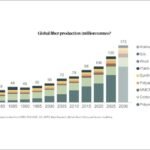
By the 1950s, natural fibres still made up the overwhelming majority of what the world wore. Then, over the following decades, the balance moved — gradually, then fast. Textile Exchange’s most recent data puts polyester at 59 per cent of global fibre production and cotton at 19 per cent1. Global clothing production doubled between 2000 and 2014. Those two shifts did not happen apart from each other.
The usual explanation is price. Polyester is cheaper at scale, and it got cheaper as scale increased. The fuller explanation is control. Cotton needs land, a season, a harvest grown somewhere specific — usually in someone else’s country. Polyester needs none of that. It needs a factory, sited wherever labour costs the least that quarter. Manufacturing synthetic fibre broke the industry’s dependence on land and climate entirely, which is also why nobody had to pass a law this time to make cotton lose ground.
The first shift needed legislation. The second needed nothing but a supply chain that no longer required anyone’s permission.
It’s been nearly 80 years since Independence ended one kind of control over this fibre. This August, as India marks its 80th Independence Day, cotton’s share of what the world wears has fallen from 95 per cent to under 20 per cent — not because it was banned this time, but because almost nobody was asked. No law taxed it out. No policy replaced it. It just stopped being the default, decision by decision, made somewhere upstream of the person wearing the shirt.
So the question isn’t only historical anymore. If Independence meant a country got to decide what it grew and wove, who decides what goes into your clothes today? That was always the rest of the point of the spinning wheel: not just to weave, but to choose. Eighty years on, if we still don’t ask what we’re wearing or why, what exactly did we win back?