US Apparel Imports Decline During Jan-May 2026 With Sharp Slide in China Shipments
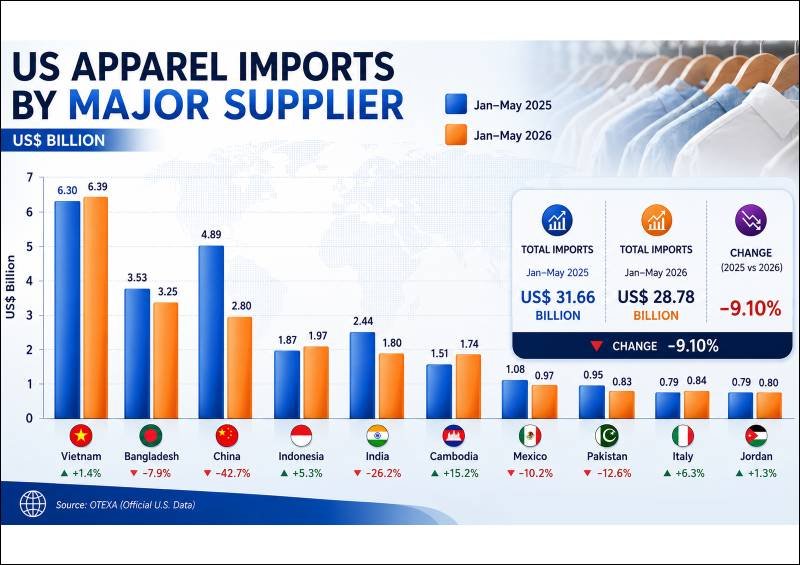
US apparel imports continued to weaken during the Jan-May 2026 period, with total imports falling by 9.1 per cent compared with the same period last year, reflecting softer sourcing activity and a sharp decline in shipments from China.
According to the latest trade data, US apparel imports during the January–May 2026 period were valued at US$ 28.78 billion, down from US$ 31.66 billion in the corresponding period of 2025.
China, once the dominant supplier to the US apparel market, recorded the steepest decline among major sourcing countries. Imports from China fell by 46.6 per cent year-on-year to US$ 8.53 billion during the period, compared with US$15.98 billion a year earlier. The sharp contraction further accelerated the diversification of US sourcing away from China.

Vietnam strengthened its position as the largest apparel supplier to the US market, with imports rising 6.0 per cent to US$ 16.82 billion. Cambodia emerged as one of the strongest performers among major exporters, registering a 25.4 per cent increase to US$ 5.05 billion, while Indonesia recorded growth of 6.4 per cent to US$ 4.76 billion.
India, however, saw apparel exports to the US decline by 14.7 per cent, falling to US$ 4.30 billion from US$ 5.04 billion in the same period last year. Bangladesh, the third-largest supplier, remained relatively stable with imports easing marginally by 0.8 per cent to US$ 7.90 billion.
Among other leading sourcing destinations, Italy posted a 6.6 per cent increase to US$ 2.10 billion, while Jordan registered modest growth of 1.0 per cent to US$ 1.98 billion. Imports from Mexico and Pakistan declined by 6.3 per cent and 2.4 per cent, respectively.
The data highlights the continued restructuring of US apparel sourcing patterns, with Southeast Asian suppliers benefiting from shifting procurement strategies while China’s share continues to erode. Vietnam, Cambodia and Indonesia were among the key beneficiaries of this transition during the first five months of 2026.